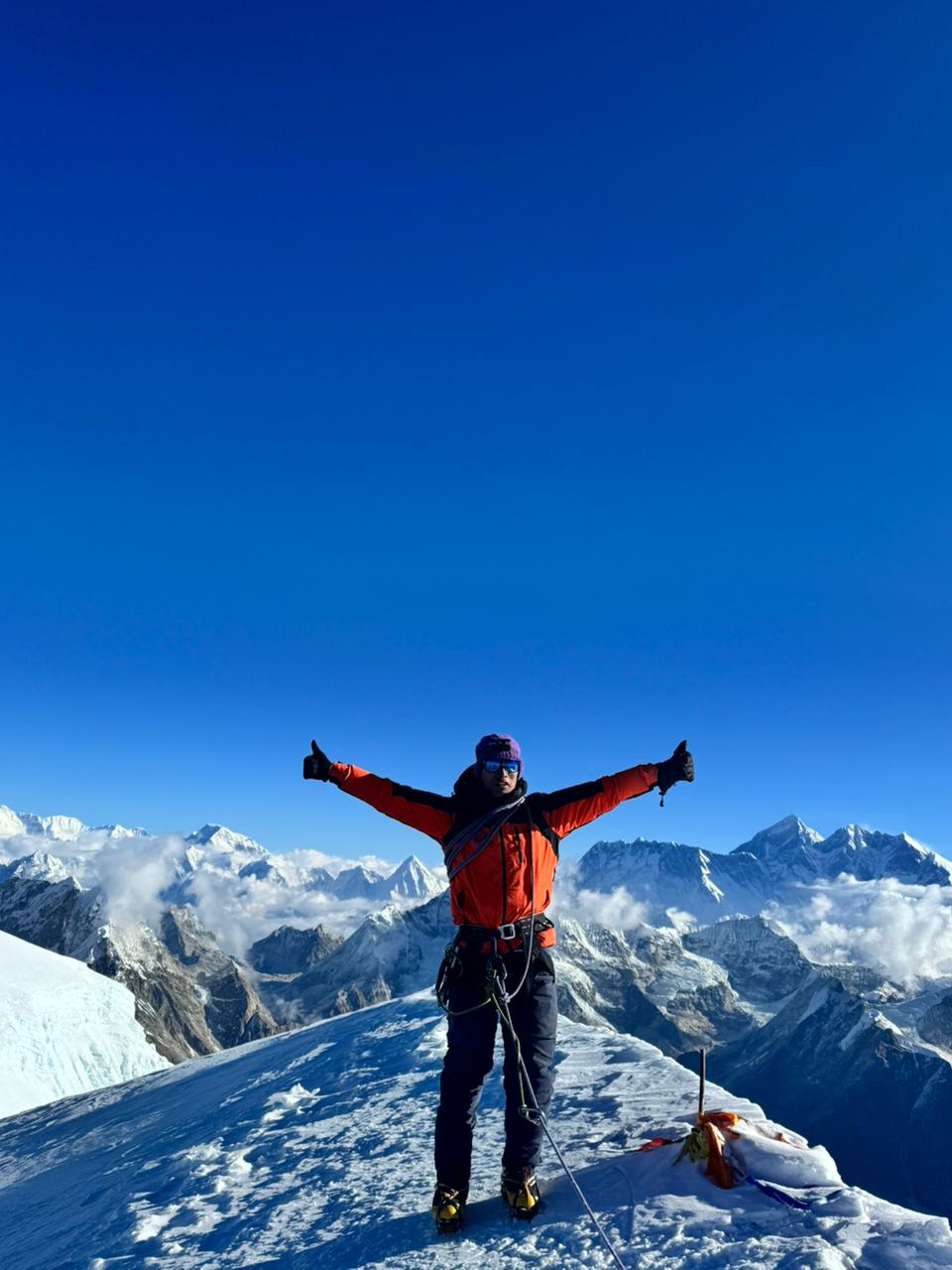
Mera Peak Climbing 17 Days

Tour Info

Trip code

M-003

Starting Point/ End Point

Kathmandu

Accommodations

Lodge/ Tea House

Max Altitude

6476m

Duration

17 days

country

Trip grade

Challenging

Best Season

Spring (March–May) and Autumn (September–November)

Highlights

  • Summit Mera Peak at 6,476 meters to have a thrilling experience of Himalayan peak climbing.
  • A scenic flight from Kathmandu to Lukla, which is the starting point for the Mera Peak region.
  • A fantastic trekking experience in the lesser-known Hinku Valley and the beautiful mountain environment.
  • Also, other lesser-known trails in Paiya, Pangom, Ramailo Danda, Chetra Khola, and Kothe.
  • Acclimatization day in Khare before you climb.
  • Overnight stay at the Mera High Camp before climbing the summit.
  • Summit day followed by descent back to Khare.
  • Experience the beautiful and grand mountain landscape of the Himalayas around Mera Peak, like Everest, Lhotse, Makalu, and so on.
  • Learn about the mountain culture of Sherpas in remote places during the trek.
  • End your trekking tour with a trek to Lukla, from where you will fly back to Kathmandu.

Overview

The Mera Peak Climbing is an exciting Himalayan journey that perfectly combines remote trekking through the Hinku Valley with the challenge of climbing Mera Peak (6,476m). Mera Peak is considered one of the highest trekking points of Nepal, and this journey begins with a scenic flight from Kathmandu to Lukla. Following this flight, you head through the less-crowded mountain trails through Paiya, Pangom, Ramailo Danda, Chetra Khola, Kothe, Thaknak, and Khare. With gradual ascent into the trip, the changing landscapes, alpine forests, stunning valleys, and surrounding regions will offer you splendid views and a fascinating trekking experience away from the more crowded Everest routes.

After arriving at Khare, you get a chance for a day to acclimatize yourself to prepare for the high altitude and difficult summiting. The journey will move forward towards Mera High Camp and an early summit push to the summit of Mera Peak. From the top of Mera Peak, you will be able to admire some of the most stunning views of some of the tallest mountains of the world. After descending down to Khare, you will start retracing your way back through Kothe and Chetarwa till you reach Lukla and take a flight to Kathmandu.

Itinerary

Day 1: Arrival in Kathmandu

The Mera Peak expedition starts from day one, that is from the day you land at Tribhuvan International Airport, Kathmandu. Once the immigration procedure is completed and the baggage collected, you will then be taken to the hotel. As soon as you check-in to the hotel, you can relax and get refreshed from your travel, or else you can go out and explore the area outside the hotel if time and energy permit. Kathmandu is a lively city that has traditional temples, historic structures, bustling markets, and modern neighborhoods all within its vicinity. In the evening, you might get an opportunity to meet your guide and get acquainted with the forthcoming adventure. You stay for the night in a Kathmandu hotel.

  • Maximum Elevation: 1,400 m
  • Travel Distance: Approx. 5–10 km
  • Travel Hours: Approx. 30–60 minutes
  • Accommodation: Hotel in Kathmandu
  • Meals: Welcome Dinner
Day 2: Mera Peak Climbing Preparation and Permit Day

This is the day when all the preparation will take place for your Mera Peak climb. You will meet your climbing guide as well as trekking team for an informative discussion regarding the route, altitude, weather, trekking conditions, climbing methods, and safety measures. Arrangements will also be made by the team for the relevant permits and other administrative preparations for your expedition. You will have your climbing gear checked for all the essential items for your climb. In case there are any missing items, you may purchase or rent any item from one of the numerous trekking shops available in Kathmandu. You will also get some time to pack your bags for an early trip to Lukla the next day. The remaining part of the day will be spent resting and conservation of energy before the trek starts. The day ends with staying overnight in a Kathmandu hotel.

  • Maximum Elevation: 1,400 m
  • Travel Distance: Minimal/local travel
  • Accommodation: Hotel in Kathmandu
  • Meals: Breakfast, lunch and dinner
Day 3: Flight to Lukla and Trek to Paiya

After your early breakfast, you depart for Lukla by air, either from Kathmandu or from Ramechhap Airport, depending on the flight schedule and operating conditions. The flight gives you an opportunity to admire the breathtaking views of the hills and mountains in the Himalayan range before reaching the well-known mountaineer's strip in Lukla. After being welcomed by your trekking team and sorting out your stuff, you start trekking from Lukla to Paiya. In the beginning, your route runs across the green hills and forests but gradually becomes more deserted. Your trek to Paiya today features a number of ascents and descents, thus introducing you to the terrain that will be part of your trekking adventure. Paiya is a peaceful place surrounded by picturesque mountain villages and wooded hills. It is a small settlement where you stay for your first night in the mountains. 

  • Maximum Elevation: Approx. 2,730 m
  • Travel Distance: Approx. 7–9 km trekking
  • Travel Hours: Approx. 5–6 hours trekking + flight
  • Accommodation: Teahouse in Paiya
  • Meals: Breakfast, lunch and dinner
Day 4: Trek to Pangom

After breakfast, you begin the trek towards Pangom through a path that passes through thick forests and mountains. There are quite a few steep sections along the trail, and it is vital that you keep a steady speed. Some rivers will be crossed on the trail, and you will be trekking through areas that have many rhododendrons, pine trees, and other kinds of flora that grow in the Himalayas. As the trek becomes higher up, the surroundings begin opening up, giving you views of the surrounding hills and peaks of the Himalayas. The path is much quieter than that of the base camp of Mount Everest, and therefore it makes this part of the trek quite an attractive destination for trekkers. After reaching Pangom, a mountain settlement, you can see some aspects of the Sherpa culture and lifestyle. After having settled at the teahouse, you can just sit down and look at the surroundings, and the guide will brief you about the route tomorrow.

  • Maximum Elevation: Approx. 2,850 m
  • Travel Distance: Approx. 8–10 km
  • Travel Hours: Approx. 5–6 hours
  • Accommodation: Teahouse in Pangom
  • Meals: Breakfast, lunch and dinner
Day 5: Trek to Ramailo Danda

Your trek today starts from Pangom towards Ramailo Danda, traversing through one of the relatively serene parts of the Mera Peak trek. After leaving the village, you shall have to go uphill and downhill through several forested ridges where the view keeps changing. The trek shall take you through the dense Himalayan forests; if the weather allows you, you will be able to enjoy the faraway views of snowy mountain ranges rising above the ridges. With forests, wide mountain slopes, and remote trails, this part of the Mera Peak trek is rather picturesque. You shall finally reach Ramailo Danda, which will allow you to admire the beautiful surroundings. After several hours of trekking, you will finally arrive at your lodge. Considering that your trek will steadily gain altitude in the following days, make sure that you drink enough water during the day and keep a good pace.

  • Maximum Elevation: Approx. 3,276 m
  • Travel Distance: Approx. 11–12 km
  • Travel Hours: Approx. 6–7 hours
  • Accommodation: Teahouse/lodge at Ramailo Danda
  • Meals: Breakfast, lunch and dinner
Day 6: Trek to Chetra Khola

In this particular adventure of the day, you will go much deeper inside the isolated valley of the Hinku Valley in order to reach the point of Chetra Khola. The route you will take will pass through peaceful forests which have mainly pine, rhododendron and other flora of the Himalayan region. There are some ups and downs as well on your route. You will hear the sound of streams and the calmness of the forest as well as get occasional clear views of the rugged mountains around you. With each step that you take, you will feel more and more like you are in a wild and unexplored area. Chetra Khola is an isolated place situated close to the river and offers a cozy stay for the night. Once you reach there, you will have a meal and stay overnight at the teahouse.

  • Maximum Elevation: Approx. 3,150 m
  • Travel Distance: Approx. 14–15 km
  • Travel Hours: Approx. 6–7 hours
  • Accommodation: Teahouse in Chetra Khola
  • Meals: Breakfast, lunch and dinner
Day 7: Trek to Kothe

After breakfast, you move further down the Hinku Valley to reach Kothe. This involves hiking on the route that follows the Hinku Valley, surrounded by wonderful forests, with the Hinku River being part of the trail at times. You will hike deep into the valley where the terrain changes as you hike, with forest cover diminishing and mountainous terrain dominating. You pass through some clearings and patches of forest as you continue ascending. Kothe serves as a very important place in the itinerary of the trekking of Mera Peak and has often been used by trekkers and climbers who travel to Thaknak and Khare. Kothe is where you make a transition towards the upper part of the adventure journey. You will spend the night at Kothe after reaching there and resting at the teahouse.

  • Maximum Elevation: Approx. 3,600 m
  • Travel Distance: Approx. 13–14 km
  • Travel Hours: Approx. 6–7 hours
  • Accommodation: Teahouse in Kothe
  • Meals: Breakfast, lunch and dinner
Day 8: Trek to Thaknak

This day's hike leads you deeper into the upper part of Hinku Valley en route to Thaknak. The hike will take you up the hill in a changing terrain with dense forest transitioning into the alpine landscape. You trek through some parts of Hinku River with increasingly spectacular scenery of the peaks, rocky cliffs, and the valleys of the mountains. Since you will be going through the higher regions, your hiking will be slow and will need several stops to acclimatize. Thaknak is a small temporary settlement that acts as a major resting site for climbers en route to Mera Peak. The humble environment along with the high altitude will make you feel like you have reached the mountaineering phase of your trip. You can take a rest at the tea house, have your dinner, and get ready for the next day’s trek to Khare.

  • Maximum Elevation: Approx. 4,326 m
  • Travel Distance: Approx. 8–9 km
  • Travel Hours: Approx. 4–5 hours
  • Accommodation: Teahouse in Thaknak
  • Meals: Breakfast, lunch and dinner
Day 9: Trek to Khare

Today you trek towards Khare, which is used as the base camp for the Mera Peak climbing stage. The trail gradually rises through the difficult and arid terrain as you leave behind the valley region. Today you get an opportunity to see the slopes of the high mountains, glaciers, and peaks around the area. As the landscape changes due to the rising altitude, there will be less vegetation and a more rocky landscape. Though the journey is not long, altitude makes the walk tougher, and hence, the guide will keep up a steady pace throughout the hike. Once you reach Khare, you will settle down at the tea house. Khare is situated under the magnificent slopes of Mera Peak. Your guide will brief you about the acclimatization plans of the next day along with the route to Mera High Camp and Mera Peak. You spend the night at Khare.

  • Maximum Elevation: Approx. 5,000 m
  • Travel Distance: Approx. 8 km
  • Travel Hours: Approx. 3–4 hours
  • Accommodation: Teahouse in Khare
  • Meals: Breakfast, lunch and dinner
Day 10: Acclimatization Day at Khare

Today will be an important day of acclimatization and preparation at Khare. Instead of spending the day doing nothing at all, you will go on a brief hike through the nearby high-altitude terrain in order to prepare your body before going even higher. It is also an opportunity to receive training from your climbing guide regarding how you need to use your equipment to reach the summit. It may include practice in using crampons, harnesses, ice axes, ropes, and other mountaineering equipment. Today, however, is also going to give us an opportunity to learn how to move on snow and ice and become familiar with safety measures while climbing the upper section of the route. The rest of the day will be dedicated to rest and preparation for our ascent to Mera High Camp.

  • Maximum Elevation: Approx. 5,000 m
  • Travel Distance: Approx. 3–4 km
  • Travel Hours: Approx. 2–4 hours
  • Accommodation: Teahouse in Khare
  • Meals: Breakfast, lunch and dinner
Day 11: Trek to Mera High Camp

This is the day when you take leave of Khare and start your journey to Mera High Camp. This marks the transition from regular trekking at high altitudes to climbing on the adventure trail. The route now becomes more difficult as you move along on the rocks and snow to the upper altitudes of Mera Peak. Depending upon the conditions, you can now use your climbing equipment under the guidance of your climbing instructor. Today you trek towards Khare, which is used as the base camp for the Mera Peak climbing stage. The trail gradually rises through the difficult and arid terrain as you leave behind the valley region. Today you get an opportunity to see the slopes of the high mountains, glaciers, and peaks around the area. The remaining part of the day is utilized in taking rest for the tough task that awaits you tomorrow. The evening is also dedicated to hydration, equipment check and briefing by your climbing guide. An early dinner is had to ensure plenty of sleep before dawn the next morning.

  • Maximum Elevation: Approx. 5,780 m
  • Travel Distance: Approx. 6–7 km
  • Travel Hours: Approx. 5–6 hours
  • Accommodation: Tent/camp at Mera High Camp
  • Meals: Breakfast, lunch and dinner
Day 12: Mera Summit and Descent to Khare

Today marks the most difficult and rewarding day of your climb up Mera Peak. You wake up very early in the morning, even before dawn, and start climbing the peak with the help of your expert climbing team. The climb involves crossing snow and ice fields, where the use of crampons, harnesses, ropes, and other such climbing equipment is possible based on the conditions. The climb is very strenuous in nature because of the tough terrain and weather, besides the high altitude of the peak. The final destination of your climb is the summit of Mera Peak at 6,476 meters. If the weather permits, the summit affords some breathtaking views of some of the highest mountains in the world, such as Everest, Lhotse, Makalu, and Baruntse. After enjoying and capturing photos of the breathtaking views, you descend and return to Khare to enjoy your meal. 

  • Maximum Elevation: 6,476 m
  • Travel Distance: Approx. 15–18 km
  • Travel Hours: Approx. 10–12 hours
  • Accommodation: Teahouse in Khare
  • Meals: Breakfast, lunch and dinner
Day 13: Trek to Kothe

Once you complete the climbing of Mera Peak, you start descending from Khare towards Kothe. On this day, you retrace your path via the Hinku Valley Trail, which starts from Thaknak and continues further into lower altitudes. This day's trekking pace is a little slower than yesterday's climb due to the fact that you might still be a little tired after climbing and descending from the peak. During the trek, the scenery becomes more lush as you descend. You will be trekking along the sections of the Hinku River during the trek, and the surrounding scenery will give you pleasure. At the end of the trek, Kothe offers you a chance to take a break and relax for some time.

  • Maximum Elevation: Approx. 5,000 m at the start
  • Travel Distance: Approx. 14–15 km
  • Travel Hours: Approx. 6–7 hours
  • Accommodation: Teahouse in Kothe
  • Meals: Breakfast, lunch and dinner
Day 14: Trek to Chetarwa

On this day, you will be embarking on your trek back through Hinku Valley to reach Chetarwa. The path slowly takes you towards lower and greener areas along the forests and mountainscapes of the region. There will be sections where you will experience both ascent and descent as you move towards the region of Lukla. Moving from such an alpine environment to a forested area marks a difference for you. The trekking path remains quite peaceful, which makes you able to take in nature and reflect on what has happened so far. Getting closer to the village of Chetarwa, you will see more vegetation and mountain villages. After you arrive in the village, you will be able to rest in the teahouse and have your dinner.

  • Maximum Elevation: Approx. 3,600 m
  • Travel Distance: Approx. 14–15 km
  • Travel Hours: Approx. 6–7 hours
  • Accommodation: Teahouse in Chetarwa
  • Meals: Breakfast, lunch and dinner
Day 15: Trek to Lukla

This is the final day of trekking for you. You will have breakfast first, and then start moving from Chetarwa to Lukla through the green hills and mountain villages. The track is generally descending, and the terrain through which you will be traveling is that of the Himalayas. You will find that walking at lower altitudes is easier compared to the high altitudes that you trekked in during your trek, but you might feel a little tired from all the previous days of effort. On arriving in Lukla, you check in at your place of stay and take some rest. You can spend your afternoon by exploring the town, having a drink or meal, or just relaxing after successfully finishing the trekking part of your Mera Peak expedition.

  • Maximum Elevation: Approx. 2,860 m
  • Travel Distance: Approx. 13–15 km
  • Travel Hours: Approx. 6–7 hours
  • Accommodation: Teahouse/lodge in Lukla
  • Meals: Breakfast, lunch and dinner
Day 16: Flight to Kathmandu

Following breakfast, you will take a plane from Lukla Airport to fly back to Kathmandu. The brief trip will give you yet another chance to see the amazing scenery from the air. There could be some weather-related delays in the scheduling of flights from Lukla, so you need to remain flexible. Following your flight to Kathmandu, you will be taken to the hotel where you will spend the day at leisure. You will have the opportunity to rest following your trek or to go sightseeing in Kathmandu and purchase some gifts to remind you of your adventure on Mera Peak. It will also be the perfect time for you to take a shower and sort out all of your things in preparation for your onward journey.

  • Maximum Elevation: Approx. 1,400 m
  • Travel Distance: Approx. 5–10 km by road + flight
  • Travel Hours: Approx. 30–60 minutes flight + transfers
  • Accommodation: Hotel in Kathmandu
  • Meals: Breakfast, lunch, and dinner
Day 17: Final Departure

This is the final day of your 17-day Mera Peak Climbing program. After breakfast, you will be free to do as you like according to your international flight schedule. In case your flight takes place in the latter part of the day, you can use the rest of the time at leisure in the hotel or just walk around Kathmandu. A representative will take you to Tribhuvan International Airport on time when it's time for you to leave. On your way out of Nepal, you will carry with you memories of the Hinku Valley, peaceful mountain villages, the mountain terrain, and, of course, the accomplishment of climbing the summit of Mera Peak. 

  • Maximum Elevation: 1,400 m
  • Travel Distance: Approx. 5–10 km
  • Travel Hours: Approx. 30–60 minutes
  • Meals: Breakfast

Lukla flight

Most trekkers reach the Everest region via a short, scenic flight to Tenzing-Hillary Airport (LUA) in Lukla. During the peak trekking seasons (March–May and October–November), flights are often rerouted to depart from Manthali Airport in Ramechhap instead of Kathmandu to reduce air traffic congestion.Most trekkers reach the Everest region via a short, scenic flight to Tenzing-Hillary Airport (LUA) in Lukla. During the peak trekking seasons (March–May and October–November), flights are often rerouted to depart from Manthali Airport in Ramechhap instead of Kathmandu to reduce air traffic congestion.

Most trekkers reach the Everest region via a short, scenic flight to Tenzing-Hillary Airport (LUA) in Lukla. During the peak trekking seasons (March–May and October–November), flights are often rerouted to depart from Manthali Airport in Ramechhap instead of Kathmandu to reduce air traffic congestion.Most trekkers reach the Everest region via a short, scenic flight to Tenzing-Hillary Airport (LUA) in Lukla. During the peak trekking seasons (March–May and October–November), flights are often rerouted to depart from Manthali Airport in Ramechhap instead of Kathmandu to reduce air traffic congestion.

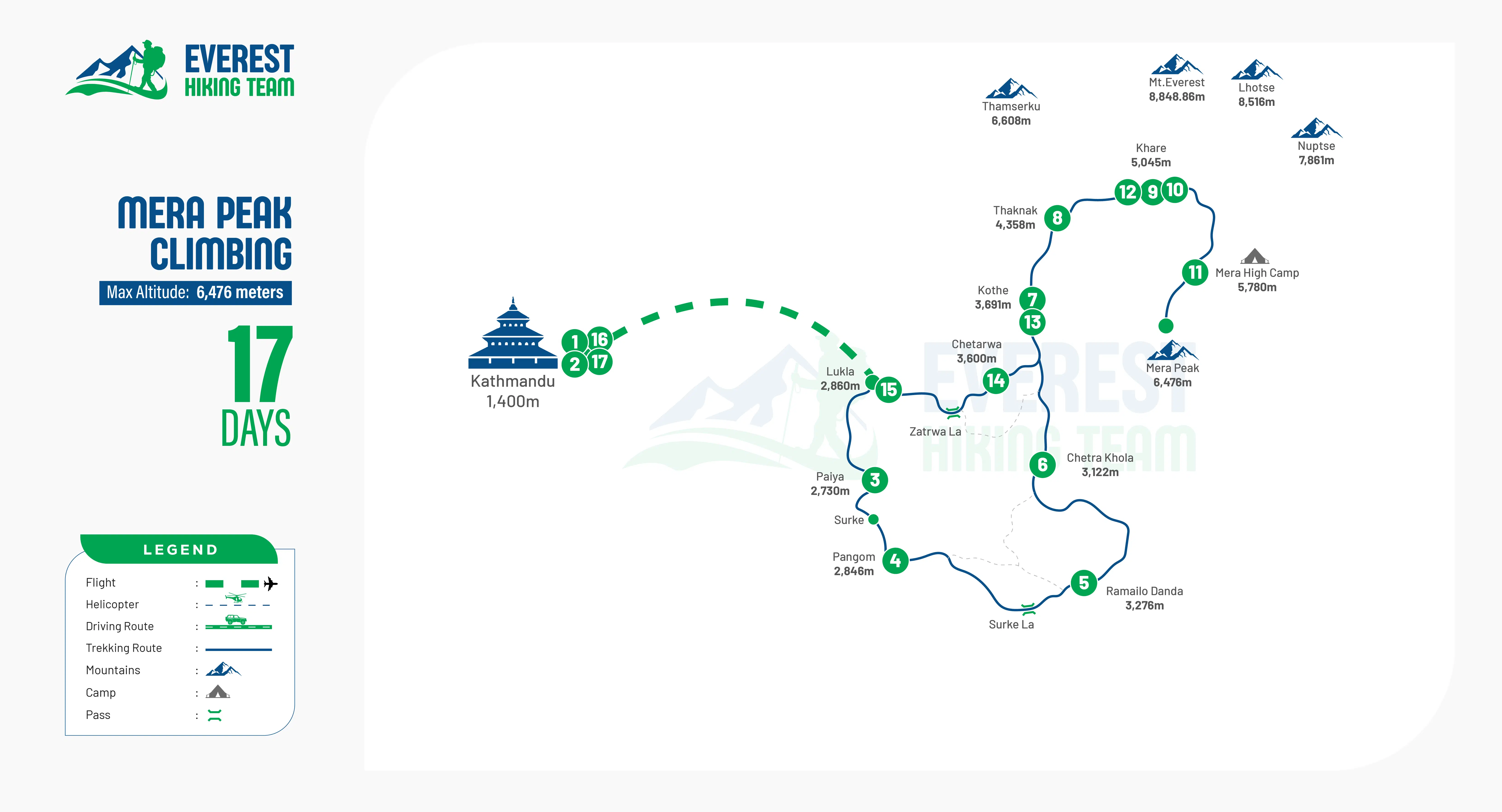
Trek Route

Mera Peak Climbing 17 Days route image

What's included

  • Airport pickup and drop-off in Kathmandu.
  • 3 nights Hotel accommodation in Kathmandu.
  • Domestic flight from Kathmandu to Lukla and return flight from Lukla to Kathmandu.
  • Mera Peak climbing permit and required trekking permits.
  • Experienced, licensed trekking and climbing guide.
  • Sherpa/Climber Support for the ascent of Mera Peak.
  • Portering during the trek.
  • Teahouse/Lodge during the trek.
  • Camping at Mera High Camp.
  • Breakfast, Lunch and Dinner with the 3 cup of tea/coffee per day  during the trekking & climbing period.
  • Meal and Tent facilities at Mera High Camp.
  • Important climbing equipment needed for Mera Peak such as crampons, harness, ice axe and rope.
  • Accommodation, food, salaries, and all other costs of guide, climbing team, and porters.
  • First aid box and medicine.
  • Government taxes and applicable service charges.
  • Necessary ground transportation related to the itinerary.
  • Mera peak climbing trekking map.

What's excluded

  • International airfare to and from Nepal.
  • Nepal entry visa fee.
  • Travel Insurance for trekking at altitude, climbing on Mera Peak and emergency evacuation.
  • Emergency evacuation and rescue costs by helicopter.
  • Personal medical expenses and drugs.
  • Personal trekking clothing and gear such as trekking shoes, clothes, gloves, sunglasses and backpacks.
  • Personal climbing equipment which is not included in the climbing equipment package.
  • Cost of food and personal expenses in Kathmandu.
  • Mineral water, soft drinks, alcoholic drinks and refreshments.
  • Extra expenses for hot shower, wi-fi, battery charging, laundry and internet facilities during the trek.
  • Tips for trekking guide, climbing Sherpa, porters and other crew members.
  • Any extra cost incurred due to delay or cancellation of flight to Lukla.
  • Any other additional cost incurred due to bad weather, landslide, change of route, sickness or any other reasons.
  • Any additional services or expenses other than mentioned in the cost inclusions.

Packing List

Packing properly is one of the key aspects of trekking, especially if you are going on a high trek like Mera Peak. On this journey, you go from lower-forested areas around Lukla and Paiya to high-altitude regions of Khare. Thus, you will experience changing temperatures, strong winds, snow, and cold conditions during the climbing session. This is why a proper layering system along with suitable clothing must be made. The list of some of the essential things required for Mera Peak Climbing includes:

Clothing (Layering System)

  • 2–3 lightweight moisture-wicking T-shirts
  • 2 thermal base-layer tops and bottoms
  • 2–3 quick-dry trekking shirts
  • 2 pairs of quick-dry trekking pants
  • 1 pair of warm or insulated trekking pants
  • Fleece jacket or warm mid-layer
  • Lightweight down or insulated jacket
  • Heavy insulated/down jacket for high-altitude sections
  • Waterproof and windproof shell jacket
  • Waterproof trousers or shell pants
  • Warm hat or beanie
  • Sun hat or cap
  • Neck gaiter or buff for wind and dust protection
  • Lightweight liner gloves
  • Warm insulated gloves
  • Waterproof outer gloves or mittens
  • 4–6 pairs of moisture-wicking or wool trekking socks
  • 2–3 pairs of warm socks for high-altitude nights
  • Comfortable thermal or warm sleepwear

Footwear

  • Well-broken-in, waterproof trekking boots with good ankle support
  • Mountaineering boots suitable for Mera Peak climbing
  • Comfortable sandals or camp shoes
  • 4–6 pairs of trekking socks
  • 2–3 pairs of liner socks
  • Gaiters for snow, mud, and loose terrain
  • Spare shoelaces

Trekking and Climbing Gear

  • 50–70L duffel bag or backpack for main luggage
  • 25–35L daypack for daily essentials
  • Sleeping bag suitable for temperatures around -15°C to -20°C
  • Trekking poles
  • Headlamp with spare batteries
  • Crampons compatible with your climbing boots
  • Mountaineering harness
  • Mountaineering ice axe
  • Climbing helmet
  • Ascender or jumar, if required by the climbing team
  • Carabiners and climbing slings, as advised by your climbing guide
  • Water bottles or hydration bladder with at least 2–3L capacity
  • Thermos flask for hot drinks
  • Water purification tablets or portable water filter
  • Dry bags or waterproof pack liners
  • Rain cover for your backpack
  • Trekking towel

Personal Items

  • Sunscreen with SPF 50+ protection
  • SPF lip balm
  • Toothbrush and toothpaste
  • Biodegradable soap
  • Hand sanitizer
  • Wet wipes or baby wipes
  • Toilet paper
  • Quick-dry towel
  • Small personal toiletries
  • Small waste bags for carrying personal waste

Health and Safety

  • Prescription medicines for personal use
  • Basic pain-relief medication
  • Altitude sickness medication, after consulting your doctor
  • Electrolytes or oral rehydration salts
  • Blister plasters and blister treatment
  • Bandages and gauze
  • Antiseptic or disinfectant
  • Basic stomach and digestive medication
  • Personal medical information and emergency contacts
  • Basic first-aid supplies
  • Travel insurance details and emergency assistance information

Electronics

  • Mobile phone and charging cable
  • Power bank, preferably 10,000–20,000 mAh
  • Universal travel adapter
  • Camera and accessories, if desired
  • Spare camera batteries or memory cards
  • Headlamp batteries
  • Charging cables for essential devices
  • Small waterproof pouch for electronics
  • Optional but Useful
  • Energy bars, chocolates, nuts, and other lightweight snacks
  • Extra electrolyte packets
  • Binoculars
  • Compact camera or action camera
  • Book or Kindle for evenings
  • Small duffel-bag lock
  • Earplugs
  • Travel pillow
  • Sunglasses retainer strap
  • Small notebook and pen

Important Documents

  • Passport valid for at least 6 months
  • Valid Nepal visa or visa documentation
  • Mera Peak climbing permit and trekking permit documentation, arranged through the trekking agency
  • Travel insurance covering high-altitude trekking, peak climbing, and emergency evacuation
  • Passport-size photographs, if required
  • Copies of passport and insurance documents
  • Flight tickets and booking confirmations
  • Emergency contact information
  • Some Nepali rupees in cash, as ATM and card facilities are limited in remote areas

Essentials for Mera Peak's High-Altitude Climate

  • High-quality UV-protection sunglasses
  • Glacier sunglasses or suitable high-altitude eyewear
  • SPF 50+ sunscreen and SPF lip balm
  • Windproof and waterproof outer shell
  • Warm down or insulated jacket
  • Thermal base layers
  • Warm insulated gloves and waterproof outer mittens
  • Warm beanie or balaclava
  • Buff or neck gaiter for wind and cold
  • Moisture-wicking and warm trekking socks
  • Reliable water bottles or hydration system
  • Thermos flask
  • Waterproof gaiters
  • Face covering for cold wind and dust
  • Extra warm layers for Mera High Camp and summit day

Frequently Asked Questions

How challenging is the 17-day Mera Peak Climbing adventure?

It is described as a challenging high-altitude adventure involving long trekking days and summit climbing on its own. Prior experience in mountaineering may come in handy; however, with appropriate preparation, acclimatization and guide assistance, any physically fit and dedicated trekker can take up the challenge of reaching the summit. The summit day in particular is challenging due to the high altitude, freezing temperatures, snow and extended hours of climbing.

What is the highest point to be reached while following the Mera Peak Climbing tour itinerary?

The highest point to be reached on this tour is Mera Peak Summit, which is at 6476 meters. The itinerary includes one acclimatization day in Khare and an overnight stay in Mera High Camp before attempting the summit. On top of the peak, you will be able to have a panoramic view of Mount Everest, Lhotse, Makalu, Baruntse and other Himalayas.

Is prior climbing experience necessary for Mera Peak Climbing?

Prior climbing experience may not be necessary, but physical fitness is required to be able to cope with long days of trekking at high altitudes. The itinerary includes preparation and use of climbing gear in Khare before moving towards High Camp. Your climbing guide will assist you with instructions in technical climbs.What kind of accommodation will be provided during your Mera Peak Climbing trip?

When is the best period for Mera Peak Climbing?

The best seasons for Mera Peak Climbing are spring (from March to May) and autumn (September to November). Such kinds of seasons have good weather, good visibility of mountains, and suitable climbing weather. In the winter season, there could be very cold weather and snow, while in the monsoon season, there could be rain, clouds, and unfavorable terrain.

What are the necessary permits required for Mera Peak Climbing?

You will require the climbing permit for Mera Peak Climbing and other permits for treks in the itinerary. The permits needed are normally prepared in advance by the trekking agency before starting the expedition. You can expect your guide or the agency to arrange the permits for you before you leave Kathmandu.

What should I pack for my Mera Peak Climbing?

The layered trekking clothing, warm clothing, rainproof clothing, trekking shoes, sleeping bags, trekking sticks, and all of your personal belongings must be carried by you. In the summit attempt stage, there will be particular gear required from you, such as crampons, ice axe, harness, helmet, and others, according to your mountaineering plan. It is essential for you to carry your luggage light and handy but at the same time safe from the environment. 

User Review