Everest Base Camp Trek-12 Days

Tour Info

Trip code

E-031

Starting Point/ End Point

Kathmandu,

Accommodations

Lodge/ Tea House

Max Altitude

5,545m

Duration

12 days

country

Trip grade

Challenging

Best Season

Spring (March–May) and Autumn (September–November)

Highlights

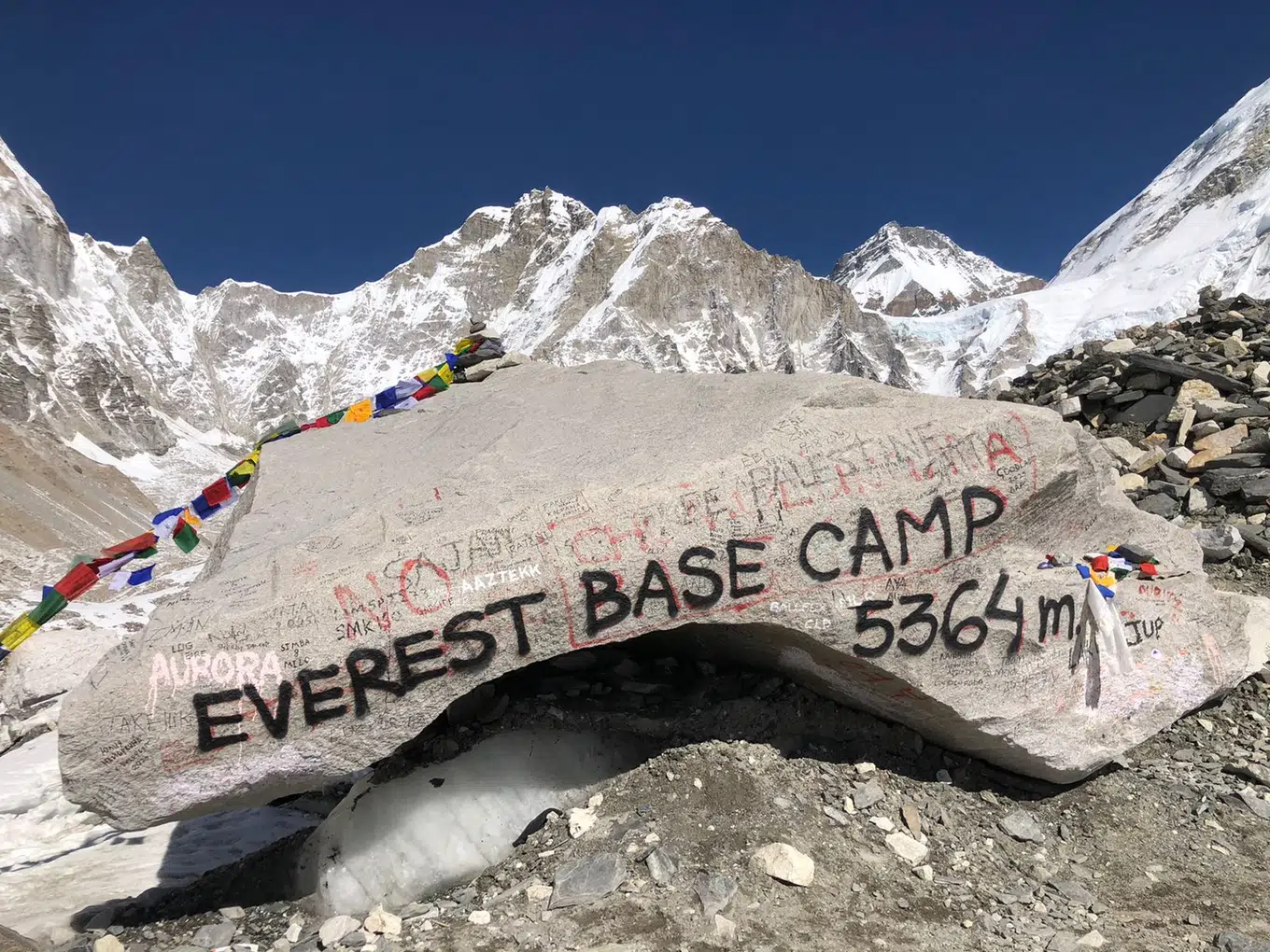
  • Reach the base camp of Mount Everest, situated at an elevation of 5,364 meters above sea level, one of the most famous trekking destinations in the world.
  • Experience magnificent Himalayan scenery with views of Mount Everest, Lhotse, Nuptse, Ama Dablam, Thamserku, Pumori, and Changtse.
  • Enjoy the beautiful natural landscape of the Khumbu region, characterized by glaciers, valleys, rocks, and mountains.
  • Explore Namche Bazaar, the commercial center for the Sherpas.
  • Acclimatize to the increasing altitude in Namche Bazaar and Dingboche.
  • Visit the well-known Tengboche Monastery and attend the Puja ceremony conducted after 3 PM.
  • Experience Sherpa culture and visit Sherpa settlements such as Phakding, Pangboche, Dingboche, Lobuche, and Gorakshep.
  • Cross suspension bridges and trek along the Dudh Koshi River through forested areas and mountain valleys.
  • Hike along the Khumbu Glacier and experience the majestic Khumbu Icefall.
  • Visit the Thukla Memorial, built in honor of climbers and Sherpas who died in the Himalayas.
  • Hike to Kala Patthar at 5,545 meters to experience sunrise over Mount Everest and its neighboring Himalayan peaks.
  • Experience the culture, monasteries, markets, bakeries, and mountaineering lifestyle of the Khumbu region.
  • Experience flight services between Kathmandu, Lukla, and the Everest region, including the alternative Ramechhap route during the peak trekking season.

Overview

The Everest Base Camp Trek 12 Days is an incredible experience where one gets to see the best places in the Khumbu region, starting from Kathmandu and ending at the base camp of Mount Everest. The tour commences with a scenic flight to Lukla and involves trekking across the Sherpa villages, through the forest, over the suspension bridge, and through the river valleys to the high-altitude areas of the Everest region.

Some of the places one will be passing by on the trek are the mountain destinations of Phakding, Namche Bazaar, Tengboche, Dingboche, Lobuche, and Gorakshep. After spending several acclimatization days in Namche Bazaar and Dingboche, trekkers make their way to the Everest Base Camp at an altitude of 5,364 meters.

One of the important highlights of this trek is the walk to Kala Patthar at 5,545 meters, from where one can enjoy the beautiful sunrise over Mount Everest, Lhotse, Nuptse, Pumori, and the surrounding glaciers. The return journey includes trekking through the same routes and places until the final flight back to Kathmandu from Lukla.

Itinerary

Day 1: Flight to Lukla (2,860m) + Trek to Phakding (2,610m) / Drive to Ramechhap (1,218m) + Flight to Lukla + Trek to Phakding

On the first day of your journey, you will have an early morning flight from Kathmandu to Lukla, one of the most thrilling airports in the world. You will have your meeting with the trekking team and start your trek to the Everest region after landing in Lukla. The trail descends gradually through the Sherpa villages, the prayer flags, and the suspension bridge along the course of the Dudh Koshi River until you reach Phakding, which is a beautiful riverside village where you can have your first overnight stay in the Everest region.

When trekking is at its peak, the flights to Lukla will be run from Ramechhap instead of Kathmandu because of traffic control of the flights and airport congestion. In such a scenario, you will first travel by vehicle from Kathmandu to Ramechhap, which usually takes 4 to 5 hours, and then you will fly to Lukla from Ramechhap Airport, which takes only about 20 minutes (0.3 hours).

This alternative way will help in maintaining the smooth operation of flights during the time of high trekking season, and you will be able to move towards the Everest region without any hindrance. In total, this trip will involve 4 to 5 hours of vehicle ride, 20 minutes (0.3 hours) of flight, and 3 to 4 hours of trekking.

  • Max Elevation: 2,860 meters (9,383 feet)
  • Travel Distance: 8 kilometers trekking
  • Travel Hours: 30–40 minutes flight + 3–4 hours trek / 4–5 hours drive, 20 minutes flight + 3–4 hours trek
  • Accommodation: Mountain lodge/teahouse
  • Meals: Breakfast, Lunch, Dinner
Day 2: Trek to Namche Bazaar (3,440m)

On this day, you can travel through the valley of Dudh Koshi via pine forests and small villages along with several suspension bridges, such as the beautiful and high bridge Hillary Bridge. Once inside the Sagarmatha National Park, the trail gets steeper and consists of a tough uphill journey. Based on the climatic conditions and visibility, you may even have the chance of viewing the peak of Mount Everest, if the luck is by your side depending on whether the weather is clear or not -  alongside other peaks such as Thamserku and Tabuche during the trip, if the weather is good. You can even see Danphe (Lophophorus impejanus) on your route towards Namche Bazaar.

  • Max Elevation: 3,440 meters (11,286 feet)
  • Travel Distance: 10–11 kilometers trekking
  • Travel Hours: 6–7 hours walk
  • Accommodation: Mountain lodge/teahouse
  • Meals: Breakfast, Lunch, Dinner
Day 3: Acclimatization Day at Namche Bazaar (3,440m)

The day is set aside for acclimatization, whereby you will allow your body to slowly get accustomed to the rising altitudes. You will not spend the whole day at rest since you will have an easy hike from Namche Bazaar all the way to the Everest View Hotel, which is one of the most favored locations for viewing the entire Khumbu region.

During the hike, you will be treated to some of the best views of the Everest range, including Everest, Ama Dablam, Mt. Thamserku, Tabuche Peak, and Lhotse. Once you get back to Namche Bazaar, there will be some leisure time for you to explore the town. The town of Namche is situated at 3,440 meters above sea level, making it the most important town in the Everest region and the largest trading center for Sherpas and trekkers to the glaciers.

Namche Bazaar has bakeries, cafes, trekking shops, local markets, ATM, banks, monasteries and museums that celebrate the Sherpa culture. As you walk around Namche Bazaar, you will continue with your process of acclimatization by exploring the local life of people. In case you make the journey during the weekend, you will also get the chance of attending the famous Saturday Market in the town.

  • Max Elevation: 3,880 meters (12,729 feet)
  • Travel Distance: 5–6 kilometers hiking
  • Travel Hours: 3–4 hours walk
  • Accommodation: Mountain lodge/teahouse
  • Meals: Breakfast, Lunch, Dinner
Day 4: Trek to Tengboche (3,867m)

Once you have passed through Namche Bazaar, the trekking starts with ridge walking that will give you stunning views of the entire Himalayan range. Mt. Everest, Ama Dablam, Lhotse, Thamserku, and Thamserku will remain prominent from the skyline as you proceed on the journey. You will also get to see the Tengboche Monastery, an active spiritual center, which is often considered to be the capital of the monks in the region. You can also come across the musk deer, mountain goats, and the colorful prayer flags on your way.

The trail will now descend towards the Dudh Koshi River. After crossing the suspension bridge, you will start climbing uphill through the rhododendron, pine, and other types of beautiful forests. The best scenery of the trail can be seen during the spring season. As you proceed further, you will reach Tengboche, which is the site of the renowned monastery amidst the mountains.

After 3 o'clock in the afternoon, you will participate in the Puja ceremony inside the monastery, join the evening prayers and get immersed in the spirituality of Tengboche. The views of Everest, Ama Dablam, and Lhotse can also be enjoyed from your guest house.

  • Max Elevation: 3,867 meters (12,687 feet)
  • Travel Distance: 9–10 kilometers trekking
  • Travel Hours: 5–6 hours walk
  • Accommodation: Mountain lodge/teahouse
  • Meals: Breakfast, Lunch, Dinner
Day 5: Trek to Dingboche (4,410m)

This day’s walk will take you deeper into the alpine zone, where the plant life begins to thin out, and the terrain becomes increasingly wild. After walking across a suspension bridge, you get wonderful views of Ama Dablam, followed by a walk to Pangboche, the oldest settlement of Sherpas in the area, and further through vast glacial valleys.

On the way, you might come across yaks grazing on the high-altitude pastures of the mountains and experience the most intimate views of Ama Dablam that you could have imagined. In addition to this, the trail offers amazing views of Lhotse and also shows you different faces of the majestic mountain during the journey. You finally arrive at Dingboche, which boasts stunning views of the mountains around it.

  • Max Elevation: 4,410 meters (14,468 feet)
  • Travel Distance: 10–12 kilometers trekking
  • Travel Hours: 5–6 hours walk
  • Accommodation: Mountain lodge/teahouse
  • Meals: Breakfast, Lunch, Dinner 
Day 6: Acclimatization Day in Dingboche (4,410 meters)

The seventh day is set aside especially for acclimatization. This is to allow your body to get used to the rising altitudes prior to moving further into the Everest region. After having your breakfast, you will go hiking in the hills around Dingboche. The relatively gentle climb affords you breathtaking views across the Himalayan terrain that include Ama Dablam, Lhotse, Island Peak, and the Imja Valley.

This trekking uses the “climb high, sleep low” technique, allowing your body to acclimatize and still enjoy the surroundings at the same time. Having gone back to Dingboche, you will be given some time to explore this scenic Sherpa village. Here, you will be able to walk around the village, visit cafes and bakeries as well as understand the Khumbu cultures through your guide. You will see stone walls in the fields built for the protection of crops from the mountain winds and grazing animals. However, although the views around Dingboche are awesome, Mount Everest will remain concealed from view.

  • Max Elevation: 4,410 meters (Dingboche)
  • Travel Distance: 3 to 4 kilometers
  • Travel Hours: 2 to 3 hours
  • Accommodation: Tea house / Lodge
  • Meals: Breakfast, Lunch, and Dinner
Day 7: Trek to Lobuche (4,910 meters) 5 to 6 hours

After breakfast, you set out on your walk from Dingboche to Lobuche as you explore the Khumbu valley further. The trail gradually climbs in the alpine zone on the way to the Dusa River, which stems from Khumbu Glacier that we cross just beforeThukla, and takes advantage of the scenic beauty of the surrounding Himalayan region. The peak Ama Dablam can be sighted throughout the trek till Lobuche. 

There will be many pastures with yaks, gorges, and mountains that you will see while walking to Thukla (Dughla). After taking some rest and eating lunch in Thukla, you walk up to the summit of Thukla Pass, otherwise called Chupki Lhara, which takes about an hour to reach. This sacred ridge is home to many memorials of climbers and Sherpas who have lost their lives while climbing Mount Everest and other Himalayan peaks.

Next, you take the route along the lateral moraine of Khumbu Glacier, enjoying the view of Mount Pumori, Nuptse, which offers one of the best views of the trek, Lobuche East, Taboche, Cholatse, and the distant Khumbu Glacier. Having crossed through many rocks and glaciers, you reach the village of Lobuche, an important point for beginning your Everest Base Camp expedition. You stay overnight at a tea house.

  • Max Elevation: 4,910 meters (Lobuche)
  • Travel Distance: 8 to 9 kilometers
  • Travel Hours: 5 to 6 hours
  • Accommodation: Tea house / Lodge
  • Meals: Breakfast, Lunch, and Dinner
Day 8: Trek to Gorakshep (5,170 meters) 3 hours walk and Visit EBC (5,364 meters) 4 hours walk up and down

This is going to be one of the most exciting days in your whole journey towards reaching the base camp of Mount Everest. You do have to note that this day is a bit tough as the oxygen is thinner because of the high altitude. Thus you are recommended to trek slower. Following your breakfast at Lobuche, you begin hiking on the Khumbu Valley track that goes toward Gorakshep. In your journey by trekking, you can have an amazing experience of panoramic views of the Khumbu Glacier and the famous Khumbu Icefall, along with the view of mountains like Pumori, Nuptse, Lingtren, Khumbutse, Changtse, and Lho La Pass. If the weather conditions are clear, you will be able to see Mount Everest's peak standing tall above the ridges. 

After hiking for about three hours, you finally reach Gorakshep and take your rooms at the teahouse. After enjoying your light lunch and resting a bit, you continue with your journey to reach the base camp of Everest. You will go past the rock glaciers, dry lakes, and loose rocks on your journey. You will realize that as you approach the base camp, the surroundings become more amazing, characterized by huge glaciers, mountain peaks, and the Khumbu Icefall.

Reaching up to 5,364 meters above sea level at the base camp of Mount Everest is certainly an achievement worth being proud of by all of us. Once you have spent some time at the base camp and captured photos, you will return to the hotel at Gorakshep. This will take you about four hours.

  • Max Elevation: 5,364 meters (Everest Base Camp)
  • Travel Distance: 10 to 12 kilometers
  • Travel Hours: 7 hours (3 hours to Gorakshep + 4 hours EBC round trip)
  • Accommodation: Tea house / Lodge
  • Meals: Breakfast, Lunch, and Dinner
Day 9: Kala Patthar (5,545m/18,192ft) Sunrise View + Trek to Pheriche (4,250m/13,944ft)

The first thing you do in the morning is a hike to Kala Patthar in order to watch the sunrise, after which you will return to Gorakshep for breakfast. Together with the guide, you will be hiking for two hours till the spot where you get to enjoy magnificent views of Mt. Everest, Lhotse, Nuptse, Khumbuche, Pumori, Changtse, and the Khumbu Icefall and glaciers.

After sunrise and enjoying the spectacular mountain views, you will walk back to Gorakshep, which takes around one and a half hours, and have breakfast before starting the trek towards Pheriche. After breakfast, you will begin your descent towards Pheriche. Along the way, you will pass through the Thukla Memorial, Thukla Pass, river gorges, and the Khumbu Glacier, while enjoying views of the surrounding Himalayan peaks. The trail gradually descends through the rugged landscape of the Khumbu region before reaching Pheriche, where you will have dinner and stay overnight. 

  • Max Elevation: 5,545 meters
  • Travel Distance: 13 to 14 kilometers
  • Travel Hours: 6 to 7 hours
  • Accommodation: Lodge / Tea house
  • Meals: Breakfast, Lunch and Dinner
Day 10: Trek to Namche Bazaar

Having had your breakfast in the morning, you continue your journey to return to Namche Bazaar through a route that passes through Somare, Pangboche, Deboche, Tengboche, Phunki Tenga, Kyangjuma, and Sanasa.

After having had breakfast in the morning, you commence trekking back to Namche Bazaar. The route will take you through Somare, Pangboche, Deboche, Tengboche, Phunki Tenga, Kyangjuma, and Sanasa. On your trekking, you get an opportunity to view different wildlife, deep canyons formed by Dudh Koshi and Imja Khola, Tengboche monastery, and the local Sherpa villages. You spend some hours trekking and finally reach Namche Bazaar, where you have your dinner and sleep there overnight. Max Elevation: 3,440 meters

  • Travel Distance: 14 to 20 kilometers
  • Travel Hours: 6 to 7 hours
  • Accommodation: Lodge / Tea house
  • Meals: Breakfast, Lunch and Dinner
Day 11: Trek to Lukla (2,835m/9,350ft)

This is the last day of your trek to the base camp of Everest. After having an early morning breakfast, you will start the reverse trek to Lukla via the same path you took while coming from Lukla to Namche Bazaar.

On this trek, you will be passing Jorsalle, Monjo, Benkar, Tok Tok, Phakding, Ghat, Chheplung, and Chaurikharka to reach Lukla. You will have a chance to view Dudh Koshi River, Sagarmatha National Park, Sherpa Culture, and Kusum Kanguru and Thamserku mountains.

After trekking for about 6 to 7 hours, you will finally reach Lukla, where you can check in at your teahouse.

  • Max Elevation: 2,835 meters
  • Travel Distance: 18 to 20 kilometers
  • Travel Hours: 6 to 7 hours
  • Accommodation: Lodge / Tea house
  • Meals: Breakfast, Lunch and Dinner
Day 12: Flight to Kathmandu

Early in the morning, you will pack your belongings and head to Lukla Airport. Our driver will assist you in reaching the airport on time, while representatives from Everest Hiking Team will help you with the necessary boarding formalities.

You will then take a scenic flight from Lukla to Kathmandu or Ramechhap, depending on the flight schedule and operating conditions. During the flight, you can enjoy spectacular aerial views of rivers, deep gorges, agricultural land, green hills, and expanding settlements. If weather conditions are clear, you may also enjoy breathtaking views of Himalayan peaks such as Numbur Himal and Gaurishankar Himal from above.

After approximately 35 minutes of flight, you will arrive at Kathmandu or Ramechhap. If you land at Ramechhap, you will continue to Kathmandu by road. Once in Kathmandu, you can spend the remaining time visiting beautiful places, shopping for souvenirs, relaxing at your hotel, and enjoying your final dinner in the city.

  • Max Elevation: 2,880 meters
  • Travel Distance: 138 kilometers (flight)
  • Travel Hours: Approximately 35 minutes by flight
  • Accommodation: Hotel
  • Meals: Breakfast, Lunch and Dinner

Lukla flight

Most trekkers reach the Everest region via a short, scenic flight to Tenzing-Hillary Airport (LUA) in Lukla. During the peak trekking seasons (March–May and October–November), flights are often rerouted to depart from Manthali Airport in Ramechhap instead of Kathmandu to reduce air traffic congestion.Most trekkers reach the Everest region via a short, scenic flight to Tenzing-Hillary Airport (LUA) in Lukla. During the peak trekking seasons (March–May and October–November), flights are often rerouted to depart from Manthali Airport in Ramechhap instead of Kathmandu to reduce air traffic congestion.

Most trekkers reach the Everest region via a short, scenic flight to Tenzing-Hillary Airport (LUA) in Lukla. During the peak trekking seasons (March–May and October–November), flights are often rerouted to depart from Manthali Airport in Ramechhap instead of Kathmandu to reduce air traffic congestion.Most trekkers reach the Everest region via a short, scenic flight to Tenzing-Hillary Airport (LUA) in Lukla. During the peak trekking seasons (March–May and October–November), flights are often rerouted to depart from Manthali Airport in Ramechhap instead of Kathmandu to reduce air traffic congestion.

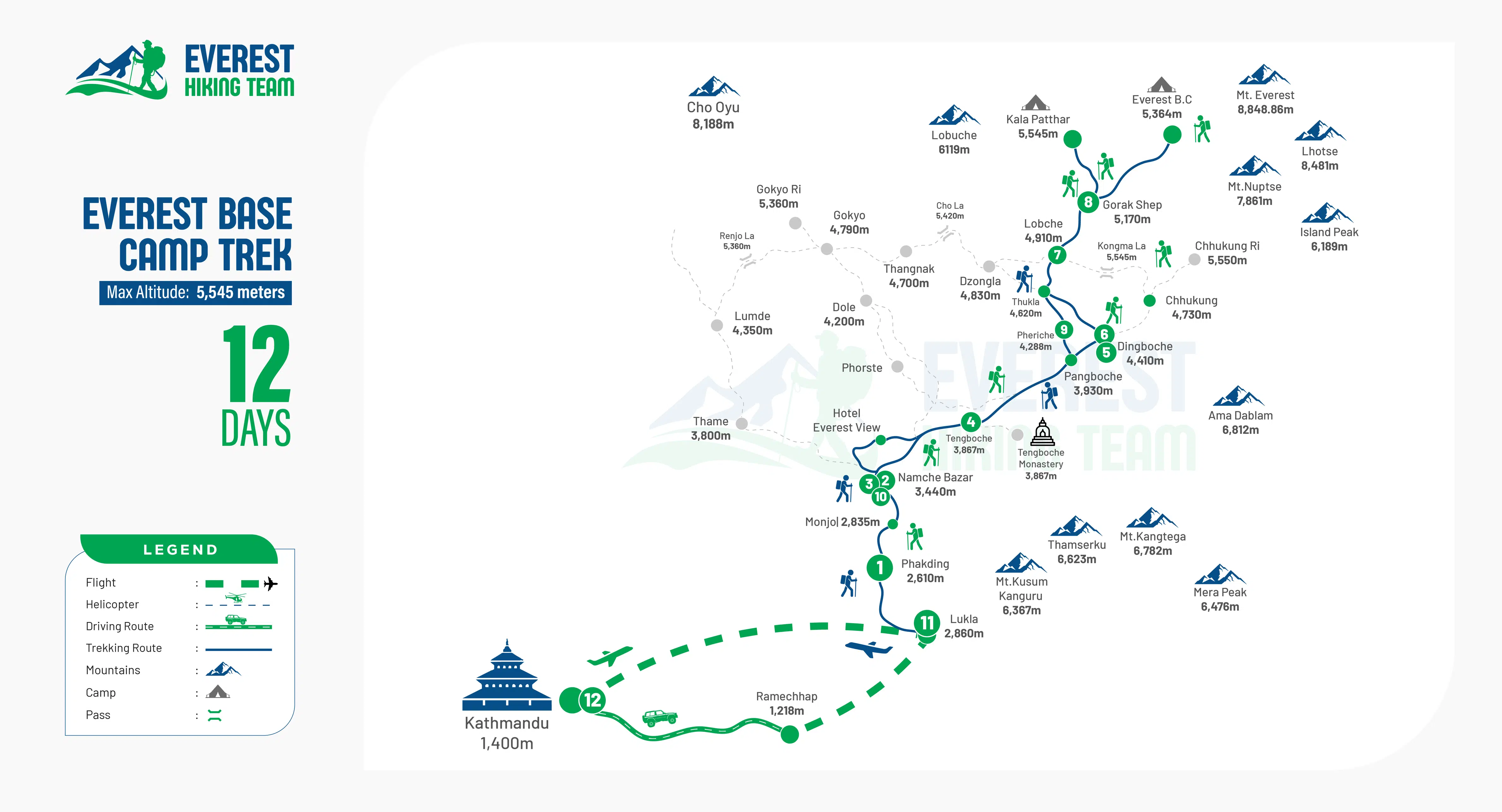
Trek Route

Everest Base Camp Trek-12 Days route image

What's included

  • Domestic Airport pickup and drop-off by private vehicle.
  • Mountain teahouse accommodation while trekking.
  • Three meals a day during the trekking period (Breakfast,lunch,Dinner with 3 cup of tea/coffee per day)
  • Welcome dinner in Kathmandu.
  • Domestic flights from Kathmandu-Lukla-kathmandu or Ramechhap-Lukla-Ramechhap During the peak season.
  • Licensed, experienced, and English-speaking trekking guide.
  • One porter for two trekkers (Weight Kimit =10-12 Kg per person)
  • Everest trekking permits.
  • Entry into Sagarmatha National Park.
  • Guide and porter accommodation, meals, salary, and insurance.
  • Necessary government taxes and service charges.
  • Basic first-aid kit carried by the trekking team.
  • Trekking map 

What's excluded

  • International airfare to and from Nepal.
  • Nepal visa fees.
  • Travel and medical insurance.
  • Emergency helicopter evacuation and rescue costs.
  • Personal trekkng gears and clothing.
  • Personal costs like drinks, alcohol, refreshments, and mineral water bottles.
  • Hot shower facilities during the mountaineering trip.
  • Internet and WiFi connectivity cost.
  • Costs related to charging of batteries and electricity.
  • Telephone and laundry fees.
  • Domestic flight extra luggage costs.
  • Costs arising from accommodation or food due to delay and cancellation of flight.
  • Tips for  guide, porters, drivers.
  • Medical expenses and medications.
  • Expenses resulting from bad weather, landslides, strikes, roadblocks, political unrest,
  • delay of flight, health problems, or any other unforeseen situation.
  • Any services or activities other than those mentioned above under cost inclusions.

Packing List

Clothing (Layered)

  • Warm and insulated down jacket suited for cold weather at higher altitudes
  • Waterproof and windproof shell jacket with features similar to Gore-tex
  • Fleece jacket
  • Two sets of base layers (top and bottom)
  • 2 pairs of quick-dry trekking trousers
  • Insulated pants for high altitude regions
  • Moisture wicking light weight T-shirts
  • Hat or beanie
  • Cap for sun protection
  • Neck buff for protection from the wind and dust
  • Lightweight gloves
  • Insulated gloves for cold weather
  • Poncho or waterproof rain cover for your backpack

Footwear

  • Comfortable and waterproof trekking boots
  • Camp shoes or sandals
  • 4–6 pairs of trekking socks preferably wool
  • 2–3 pairs of liner socks for extra warmth

Gaiters

  • Trekking Equipment
  • Backpack 50-70L for main luggage in case of trekking without a porter
  • Daypack 25-35L for daily needs
  • Sleeping bag suitable for cold weather, ideally rated for -15°C to -20°C
  • Trekking poles for uphill and downhill support
  • Headlamp with spare batteries
  • Hydration system or 2 liters of water in bottles
  • Drybags and waterproof liners for backpacks

Personal stuff

  • High-altitude sun screen with SPF 50+
  • Lip balm with SPF
  • Baby wipes or wet wipes
  • Quick dry towel
  • Toothbrush and toothpaste
  • Biodegradable soap
  • Hand sanitizer
  • Toilet paper
  • Small personal first aid kit
  • Medicines for personal use

Health and safety

  • Medicine against altitude sickness, in consultation with your doctor if necessary
  • Painkillers or antibiotics in case of need
  • Oral rehydration salts
  • Bandages and blister plasters
  • Medicines from prescription for personal use

Electronics

  • Mobile phone and charger
  • Power bank 10,000-20,000 mAh
  • Travel adapter
  • Camera if you want to take photos
  • Extra batteries due to the cold weather

Optional but useful items

  • Trekking snacks such as energy bars, chocolates, nuts
  • Insulated thermos flask
  • Binoculars for observation of the surrounding mountains
  • Book or Kindle for reading in the evenings
  • Padlock for your duffel bag

Important documents

  • Passport valid for more than 6 months
  • Nepal visa, advance one or on arrival
  • High-altitude travel insurance
  • Passport size pictures if you need for permits
  • Flight tickets and booking confirmation

Cold weather essentials

  • Down jacket and warm sleeping bag for cold nights and high-altitude parts
  • Insulated gloves, both light and warm
  • Buff or neck gaiter
  • Thermal base layers
  • Outer shell windproof jacket 

Frequently Asked Questions

How challenging is the 13-day Everest Base Camp Trek?

Everest Base Camp Trek is quite a challenging high-altitude trek due to the long walking days, tough terrain, and the increase in height. There are acclimatization days in Namche Bazaar and Dingboche planned for your gradual adjustment to the height.

What is the maximum height during the Everest Base Camp Trek?

Kala Patthar, with an altitude of 5,545 m/ 18,192 feet, is the maximum height of the trek, whereas Everest Base Camp is at an altitude of 5,364 m.

When is the best season for the Everest Base Camp Trek?

Spring (from March to May) and autumn (September to November) are the best seasons for this trekking.

Do I need acclimatization days in the Everest Base Camp Trek?

Yes. In this itinerary, there are acclimatization days in Namche Bazaar and Dingboche, which help you in the adjustment to the height while being active.

What type of accommodation is arranged during the trek?

Accommodation during the trekking period is arranged in mountain lodges or tea houses, whereas in Kathmandu there is accommodation in a 3-star standard hotel.

What do I need to take for my trip to Everest Base Camp?

You need to pack the right clothes, a warm down jacket, a waterproof outer layer, thermal inner wear, trekking pants, gloves, a warm hat, hiking shoes, trekking socks, a sleeping bag, trekking poles, a daypack, sunscreen, medicine, and other essentials you will need on your trek.

How do I get to the Everest area for the trek?

Your journey starts with a flight to Lukla that is located 2,860 m above sea level and then trekking to Phakding. For the high season, sometimes the flight can be to Ramechhap, where it will be necessary to travel for 4-5 hours from Kathmandu, and then take a 20-minute flight to Lukla.

Do I need travel insurance for the Everest Base Camp Trek?

Travel and medical insurance are very necessary, especially for trekking to such heights, because you are going to be at high altitude.

User Review