Kanchenjunga North Base Camp Trek 20 Days

Tour Info

Trip code

k-001

Starting Point/ End Point

Kathmandu

Accommodations

Lodge/ Tea House

Max Altitude

5140m

Duration

20 days

country

Trip grade

Strenuous

Best Season

March–May and September–November

Highlights

  • Base camp trek to the north side of the Kanchenjunga called Pang Pema, elevation 5,140 m.
  • Experience the incredible view of Kanchenjunga mountain, one of the highest mountains in the world.
  • Walk on the unexplored routes of the Kanchenjunga region.
  • Visit the traditional villages of the mountain region like Chirwa, Amjilosa, Ghunsa, Kambachen, and Lhonak.
  • Prepare yourself to acclimatize in Ghunsa and Kambachen for high-altitude treks.
  • Experience various types of topography such as forests, mountains, landforms, glaciers, and alpine valleys.
  • Look at the topography of Kanchenjunga Glacier.
  • Get the panoramic view of the Himalayas including Jannu (Kumbhakarna).
  • Discover the unique culture of the people living in the remote Kanchenjunga region.
  • Cross suspension bridges and take the mountain trails along Ghunsa Khola.
  • Discover how the vegetation changes from low hills to high mountains.
  • Complete a challenging trek at high altitude in 20 days. 

Overview

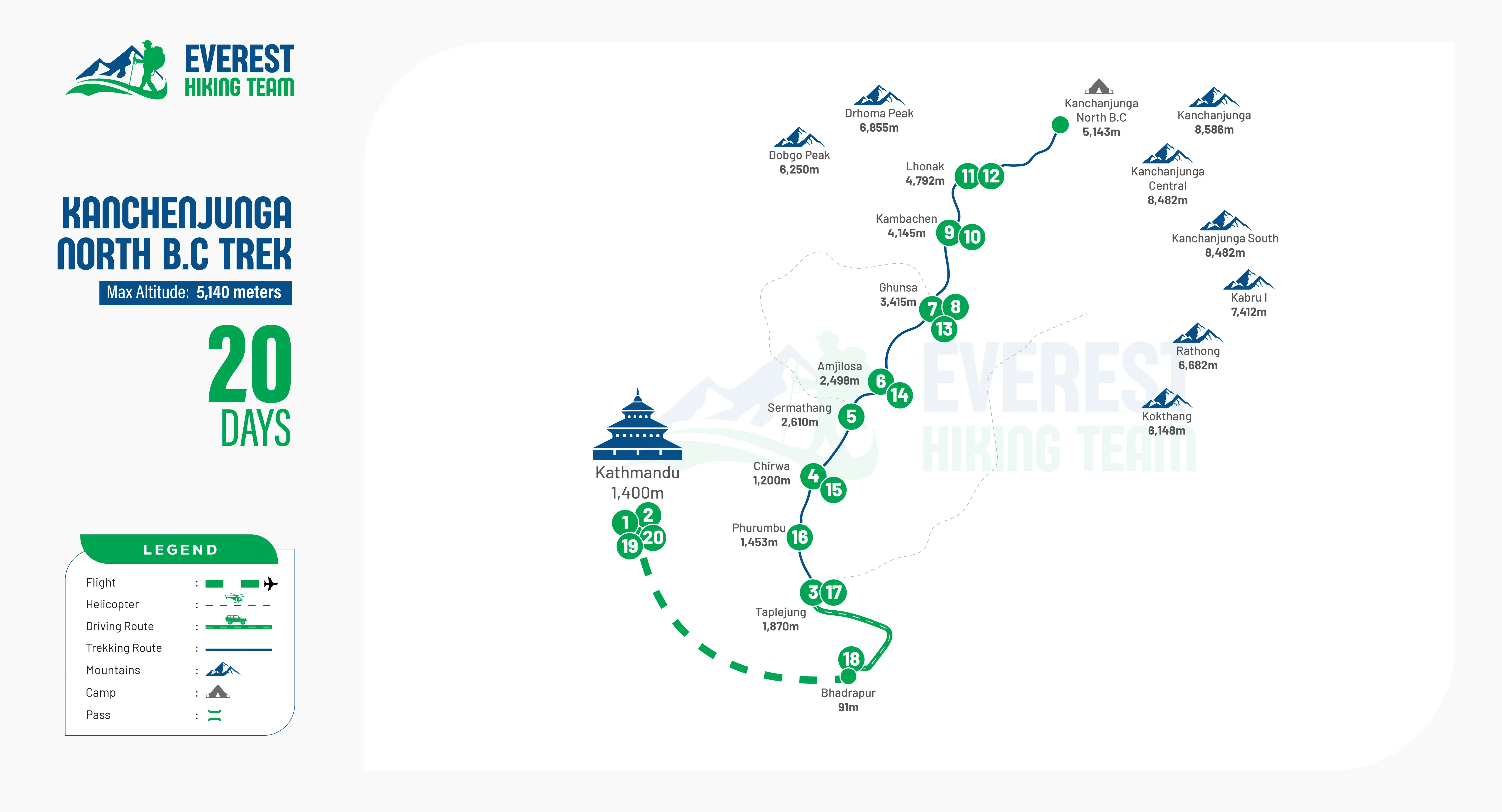
The 20 Day Kanchenjunga North Base Camp Trek is a relatively challenging Himalayan Adventure that takes you into the remote landscape in the Northeastern region of Nepal towards the northern side of the grand Mount Kanchenjunga. The adventure starts off with a flight from Kathmandu to Bhadrapur, which will be followed by a road trip to Taplejung and further trekking along the traditional mountain settlements, forests, river valleys, and progressively rugged alpine landscape. Along with increasing elevation, during your trekking, you will go through Chirwa, Amjilosa, Ghunsa, Kambachen, and Lhonak until you reach Kanchenjunga North Base Camp, popularly known as Pang Pema, located at around 5,140 meters above sea level.

This trekking itinerary also provides some days for acclimatization to help you get used to the growing altitude before moving on to the higher Himalayan valley. Moreover, once you reach the base camp Pang Pema, you get breathtaking views of the famous Mt. Kanchenjunga and other surrounding peaks with the glacier and rocky landscapes.After completing the base camp trekking, you will head back to Taplejung and then fly back to Kathmandu via Bhadrapur.

Itinerary

Day 1: Arrival in Kathmandu

After reaching Tribhuvan International Airport in Kathmandu, one of our representatives will pick you up and drop you off at the hotel. After this, you will be able to relax in your hotel room or go for a walk in the vicinity of your hotel depending on how things work out for you. At night, you will get some details regarding the Kanchenjunga North Base Camp Trek that will cover details related to your itinerary, permits, etc. You will spend the night at the hotel in Kathmandu.

  • Travel Distance: Approx. 6 km
  • Travel Hours: 20–30 minutes
  • Accommodation: Hotel in Kathmandu
  • Meals Included: Breakfast
Day 2: Permit and Trek Preparation Day

The day will be reserved for making the final preparations for your trek to Kanchenjunga. It will be the responsibility of the trekking group to obtain all the permits and documentation related to the conservation area, while you will have time to check your trekking gear. You will have plenty of time to buy or rent any additional equipment that you need. You will also need to prepare your backpack. The guide will inform you about altitude, weather, and hiking conditions.

  • Travel Hours: Full day preparation
  • Accommodation: Hotel in Kathmandu
  • Meals Included: Breakfast
Day 3: Flight to Bhadrapur and Drive to Taplejung

After having your breakfast, you will then take a flight to Bhadrapur from Kathmandu to the eastern part of Nepal. It is an opportunity for you to observe the difference in landscape as the flat valley of Kathmandu changes to the green hills of eastern Nepal. Once in Bhadrapur, you will start a long journey towards Taplejung through tortuous roadways and hills, along with some streams and villages. Taplejung is the primary point of entrance for trekking in the Kanchenjunga region. Once in Taplejung, you can check into your hotel and rest before starting trekking.

  • Travel Distance: Approx. 270 km by road from Bhadrapur to Taplejung
  • Travel Hours: 45–50 minutes flight + 8–9 hours drive
  • Accommodation: Hotel in Taplejung
  • Meals Included: Breakfast, Lunch and Dinner
Day 4: Trek to Chirwa

Your trekking experience will start from today as you move away from Taplejung and head towards Chirwa. The path will gradually guide you to the eastern hills, which are quite remote and are known for their forested mountains, terraces, small villages, and streams. There will be an easy mixture of upward and downward trails which will give you enough time to get accustomed to walking at a leisurely pace. Further, as you continue towards Chirwa, the landscape gets rugged and undeveloped. Chirwa is a small village on the Kanchenjunga trail route and a good place for an overnight stay.

  • Travel Distance: Approx. 18 km
  • Travel Hours: 7–8 hours
  • Accommodation: Teahouse/Lodge in Chirwa
  • Meals Included: Breakfast, Lunch and Dinner
Day 5: Trek to Sermanthang

After breakfast, you continue hiking along the path to Sermanthang. The trail leads you through some of the most picturesque forest areas and follows stretches of the valley of the river. Some of the trails are quite steep, which demands that you maintain a brisk pace during hiking. You will cross suspension bridges, rivers, villages, and terraced hills during your hiking trip. With each passing kilometer of hiking, the area gets more remote and quiet. This is a perfect day for familiarizing yourself with different types of landscapes before gaining elevation. After arriving at Sermanthang, you will get comfortable in your accommodations.

  • Travel Distance: Approx. 15 km
  • Travel Hours: 6–7 hours
  • Accommodation: Teahouse/Lodge in Sermanthang
  • Meals Included: Breakfast, Lunch and Dinner
Day 6: Trek to Amjilosa

Today’s journey takes us in the direction of Amjilosa. This is going to be further exploration of the region of Kanchenjunga. It entails traveling through thick forests and hills. Along the way, you will cross small rivers and suspension bridges, as you pass through isolated settlements with lots of green vegetation around them. With increasing elevation, the vegetation and landscape change, which is your first clue of being in the high Himalayan landscape. Amjilosa is an isolated mountain village amid the forested slopes and is an important overnight stop for trekkers heading to Kanchenjunga from the north.

  • Travel Distance: Approx. 12 km
  • Travel Hours: 5–6 hours
  • Accommodation: Teahouse/Lodge in Amjilosa
  • Meals Included: Breakfast, Lunch and Dinner
Day 7: Trek to Ghunsa

Following breakfast, you head off towards Ghunsa, which is one of the most significant stops on the trail to the north of Kanchenjunga. This trail takes you through the dense forest of rhododendrons, bamboo trees, pines, and various other Himalayan flora, with the trail gradually becoming more difficult as you move forward. There are sections of the Ghunsa Khola river that need to be crossed along with some bridges. With Ghunsa fast approaching, you can see the Alpine setting come into play, and you get a lot of influences from Tibetan Buddhist culture with the presence of prayer flags and mani walls.

  • Travel Distance: Approx. 18 km
  • Travel Hours: 7–8 hours
  • Accommodation: Teahouse/Lodge in Ghunsa
  • Meals Included: Breakfast, Lunch and Dinner
Day 8: Acclimatization Day at Ghunsa

Today marks one of the most significant days for acclimatization at Ghunsa. Instead of going on a long journey, you get today to let your body adapt to the rising elevation. The guide will organize a short trek around the village along with the nearby hills in order for you to get extra altitude and then head back to Ghunsa to sleep for the night. It will give you a chance to explore the village, learn about their Tibetan Buddhism culture, pay a visit to their monasteries, or just relax and enjoy the mountain scenery around.

  • Travel Distance: Approx. 2–5 km optional hike
  • Travel Hours: 2–4 hours optional hike
  • Accommodation: Teahouse/Lodge in Ghunsa
  • Meals Included: Breakfast, Lunch and Dinner
Day 9: Trek to Kambachen

This day will mark the start of the tougher part of the hike. You will leave Ghunsa, then continue following the stream of Ghunsa Khola up through forests of larch and junipers until the terrain gets more open and rugged. The path will include boulder fields and landslide/rock fall terrain, so you have to be very careful on your feet. As you ascend higher, the vegetation thins out, and the mountains around will become more apparent. Magnificent Jannu, or Kumbhakarna, will be one of the main attractions of this trail. After hiking for several hours, you will get to Kambachen – a small highland village among the majestic Himalayas. 

  • Travel Distance: Approx. 10 km
  • Travel Hours: 5–6 hours
  • Accommodation: Teahouse/Lodge in Kambachen
  • Meals Included: Breakfast, Lunch and Dinner
Day 10: Acclimatization Day at Kambachen

On this day, we have another acclimatization day scheduled at Kambachen, where your body will get accustomed to the high altitude prior to beginning the journey to Lhonak and Pang Pema. You may also take an exploratory walk among the hills and vistas located around the area. The place has a lot of scenery with views of Jannu and other mountains, glaciers, rocky cliffs, and high Himalayan valleys. Your guide will check how well you have adapted to the altitude and ensure that you drink plenty of fluids and do not exert yourself.

  • Travel Distance: Approx. 2–4 km optional hike
  • Travel Hours: 2–4 hours
  • Accommodation: Teahouse/Lodge in Kambachen
  • Meals Included: Breakfast, Lunch and Dinner
Day 11: Trek to Lhonak

Post breakfast, you leave Kambachen and proceed towards Lhonak into a more barren and glacial terrain. Your route will take you through rocky paths and fields until you reach the region surrounding Ramtang. You will have to cross or walk through areas of glacial moraine and rocky slopes while traveling in the upper valley to the Kanchenjunga Glacier region. There isn’t much vegetation here at this height, and the area will consist of rugged mountains, glaciers, and rocks. Lhonak campsite is located in a flat, sandy plateau at an elevation of around 4,780 meters. It is one of the highest elevations that you will reach on your trek.

  • Travel Distance: Approx. 9–10 km
  • Travel Hours: 5–6 hours
  • Accommodation: Teahouse/Camp in Lhonak
  • Meals Included: Breakfast, Lunch and Dinner
Day 12: Trek to Kanchenjunga North Base Camp and Return to Lhonak

Today is the most important day on your Kanchenjunga North Base Camp Trek. It will be an early morning for you as you start your trek from Lhonak to reach the base camp of Kanchenjunga at Pang Pema via a tough trail. Pang Pema is the common name for Kanchenjunga North Base Camp located at an elevation of about 5,140 meters above sea level. The trek follows the Kanchenjunga glacier all the way up to Pang Pema. Along the way, you will get amazing views of the peaks surrounding you. You will be able to get great views of the north face of Mount Kanchenjunga, as well as the Jannu, Wedge Peak, Tent Peak, and the Twins.

  • Travel Distance: Approx. 14–16 km round trip
  • Travel Hours: 7–8 hours
  • Accommodation: Teahouse/Camp in Lhonak
  • Meals Included: Breakfast, Lunch and Dinner
Day 13: Trek to Ghunsa

After having your breakfast, you will start descending from Lhonak to Ghunsa by following the same path that you came through in the high Himalayan valley. You will follow the path back to Kambachen before starting to descend through the Ghunsa Khola. Despite the fact that the trail is familiar to you since you followed it on the way up, this time it gives you an opportunity to view the landscape and the glaciers around from another angle. As you go down, the air gets lighter, and vegetation reappears. Your day of walking may be a long one, but now that you are losing altitude, walking is easier than climbing. After arriving at Ghunsa, have some rest in the teahouse.

  • Travel Distance: Approx. 18–21 km
  • Travel Hours: 7–8 hours
  • Accommodation: Teahouse/Lodge in Ghunsa
  • Meals Included: Breakfast, Lunch and Dinner
Day 14: Trek to Amjilosa

On today’s trek, you are continuing to descend from Ghunsa towards Amjilosa. The track goes along the Ghunsa Khola, which passes through forests as well as steep mountain regions, with small villages and bridges being encountered en route. The descent brings you back to low-altitude areas and hence to denser vegetation, which is made up of juniper forests, pine forests, bamboo forests, and rhododendron forests. Some parts of the track will be easy while others will be steeper, and hence trekking poles will come in handy, especially to ease the pressure on your knees. Compared with the previous days, the surroundings will now be greener and warmer.

  • Travel Distance: Approx. 15–20 km
  • Travel Hours: 6–7 hours
  • Accommodation: Teahouse/Lodge in Amjilosa
  • Meals Included: Breakfast, Lunch and Dinner
Day 15: Trek to Chirwa

After breakfast, you begin to head towards Chirwa while descending. This trek goes through the hills that are covered with forests and runs along the river valley, which includes some bridges and ups and downs. The lower altitude brings about warmer weather and more vegetation, forming a sharp contrast to the alpine terrain encountered in areas like Lhonak and Pang Pema. Your trek will run through rural landscapes and small settlements that represent the mountainous lifestyle, which forms an important aspect of the locals. While the terrain may be downhill, some uphill stretches are expected to make your trek moderately strenuous.

  • Travel Distance: Approx. 15–17 km
  • Travel Hours: 6–7 hours
  • Accommodation: Teahouse/Lodge in Chirwa
  • Meals Included: Breakfast, Lunch and Dinner
Day 16: Trek to Phurumbu

Now today’s task is for you to travel down the path towards Phurumbu. The trail you take involves lower-altitude hills, forests, rivers, and a few settlements as you make your way nearer to Taplejung. When compared with the isolated high-altitude regions, this leg of the trail gives you an entirely new experience of how people live in eastern Nepal. Traveling slowly and enjoying the surroundings as well as the hills and valleys of the rivers, you keep on thinking about the trekking you did in the Kanchenjunga region. Once you reach Phurumbu, you have to find your place to stay.

  • Travel Distance: Approx. 17–18 km
  • Travel Hours: 7–8 hours
  • Accommodation: Teahouse/Lodge in Phurumbu
  • Meals Included: Breakfast, Lunch and Dinner
Day 17: Trek to Taplejung

This is the last trekking day, and on this day, you move from Phurumbu to Taplejung. The trail will take you across the green hills of eastern Nepal, through villages, terraced fields, and forested areas. As you near Taplejung, you will be able to experience the shift from the rugged trekking area back to the road networks. Arriving at Taplejung is an indication that the trekking part of your Kanchenjunga experience is complete. On settling down in your hotel room, have some rest and enjoy the accomplishment of the trek.

  • Travel Distance: Approx. 9 km
  • Travel Hours: 4–5 hours
  • Accommodation: Hotel in Taplejung
  • Meals Included: Breakfast, Lunch and Dinner
Day 18: Drive to Bhadrapur

After having breakfast, you will head to Bhadrapur from Taplejung. This will be done by taking a journey that passes through the hilly regions of eastern Nepal along the winding roads of the mountains. This is going to be a lengthy road journey. So, you have the opportunity to enjoy the changing landscapes during the trip. As you travel down to the lowlands, the climate as well as vegetation starts getting warmer and more subtropical. Once you get to Bhadrapur, check into your hotel and rest for the night since staying overnight in Bhadrapur will give you more time for the next day's flight to Kathmandu.

  • Travel Distance: Approx. 240 km
  • Travel Hours: 8–10 hours
  • Accommodation: Hotel in Bhadrapur
  • Meals Included: Breakfast, Lunch and Dinner
Day 19: Flight to Kathmandu

You start off your journey today by flying back to Kathmandu from Bhadrapur. Once you reach Kathmandu, you will be taken to your hotel. The rest of the day is yours, so that you can relax after your strenuous trip. You can spend some time in the neighboring streets, go shopping for mementos, have your last meal in Nepal, or just stay back at your hotel. It would be a nice idea to sort out your gear and photos from your Kanchenjunga trip.

  • Travel Distance: Approx. 300 km by air
  • Travel Hours: 45–50 minutes flight
  • Accommodation: Hotel in Kathmandu
  • Meals Included: Breakfast, Lunch and Dinner
Day 20: Final Departure

Today is the official last day of your trek to Kanchenjunga North Base Camp. Depending upon your time of departure, you would have some free time in Kathmandu before your departure from Tribhuvan International Airport. Your representative would be there to transport you to the airport for your onward journey. Saying goodbye to memories of distant mountain villages, glaciers, Pang Pema, and the stunning north face of Kanchenjunga, you bid farewell to Nepal after 20 days of your adventure holiday in the Himalayas.

  • Travel Distance: Approx. 6 km
  • Travel Hours: 20–30 minutes
  • Meals Included: Breakfast

Trek Route

Kanchenjunga North Base Camp Trek 20 Days route image

What's included

  • Pick-up and drop-off service at Kathmandu Airport.
  • 3 Nights Accommodation in Kathmandu with breakfast.
  • Domestic flight from Kathmandu-Bhadrapur-Kathmandu.
  • Ground transportation between Bhadrapur-Taplejung-Bhadrapur.
  • All necessary Kanchenjunga Restricted Area Permits and Kanchenjunga Conservation Area permits.
  • All local and government trekking permits.
  • Accommodations in teahouses/lodges along the trekking trail.
  • Meals (breakfast, lunch,dinner with Cup of tea/coffee.) while on the trek
  • Experienced, government-licensed English-speaking trekking guide.
  • One Porter service for two trekkers.
  • Salary, food, lodging, transport, and insurance for the trekking guide and porters.
  • Map of Kanchenjunga trekking area.
  • First aid kit.
  • Government taxes and applicable service charges.
  • Welcome dinner in Kathmandu.

What's excluded

  • International airfare to and from Nepal.
  • Nepal entry visa fee.
  • Travel and medical insurance including high altitude evacuation insurance.
  • Helicopter evacuation charges in case of emergencies.
  • Lunch and Dinner in Kathmandu.
  • Additional hotel stay in Kathmandu in case of early arrival, late departure, flight delay, or any changes in the schedule.
  • Trekking equipment and clothes.
  • Snacks and refreshments, mineral water, soft drinks, alcohol and any other drink.
  • Hot shower, internet, battery charging, and laundry facility during trekking.
  • Personal expenses like phone calls, presents, or any other personal shopping.
  • Tips for guide, porter, driver, and other support team members.
  • Transportation and accommodation due to landslides, bad weather conditions, road blockage, flight cancellation, or other situations beyond the reach of the travel agency.
  • All additional services and costs other than those mentioned in cost inclusions.

Packing List

The packing list plays an important role in the 20-day Kanchenjunga North Base Camp Trek as the trek involves traveling from warm lowland hills to cool forests and then to cold places at Lhonak and Kanchenjunga North Base Camp. One must be ready for variations in temperature, long days of trekking, rocky and rugged paths, sun exposure, and possibly cold nights. The packing list below outlines all the necessary items one must pack before embarking on the trek.

Clothing (Layering System)

  • Lightweight moisture-wicking T-shirts
  • 2 thermal base-layer tops and bottoms
  • 2–3 quick-dry trekking shirts
  • 2 pairs of quick-dry trekking pants
  • 1 pair of warm or insulated trekking pants
  • Fleece jacket or warm mid-layer
  • Lightweight down or insulated jacket
  • Waterproof and windproof shell jacket
  • Warm hat or beanie
  • Sun hat or cap
  • Neck gaiter or buff
  • Lightweight gloves
  • Warm insulated gloves
  • Lightweight rain jacket or poncho
  • 4–6 pairs of moisture-wicking or wool trekking socks
  • 2–3 pairs of liner socks
  • Comfortable sleepwear
  • Warm base layers for sleeping at higher elevations

Footwear

  • Well-broken-in waterproof trekking boots with good ankle support
  • Comfortable sandals or camp shoes for evenings
  • 4–6 pairs of trekking socks
  • 2–3 pairs of liner socks
  • Gaiters for muddy, snowy, or rocky sections
  • Lightweight spare footwear, if preferred

Trekking Gear

  • 50–70L duffel bag or large trekking backpack
  • 25–35L daypack for daily essentials
  • Sleeping bag rated to around -10°C to -15°C
  • Trekking poles for steep ascents and descents
  • Headlamp with spare batteries
  • Water bottles or hydration bladder with at least 2–3L capacity
  • Water purification tablets, drops, or portable water filter
  • Dry bags or waterproof pack liners
  • Rain cover for your daypack
  • Trekking towel
  • Small personal lock for your duffel bag
  • Lightweight sit mat or foam pad, if desired

Personal Items

  • Sunscreen with SPF 50+ protection
  • SPF lip balm
  • Toothbrush and toothpaste
  • Biodegradable soap
  • Hand sanitizer
  • Wet wipes or baby wipes
  • Toilet paper
  • Quick-dry towel
  • Small waste bags for carrying personal waste
  • Small personal toiletries bag
  • Moisturizer for dry and cold conditions

Health and Safety

  • Prescription medicines for personal use
  • Basic pain-relief medication
  • Medication for altitude sickness, after consulting your doctor
  • Electrolytes or oral rehydration salts
  • Blister plasters and blister treatment
  • Bandages and gauze
  • Antiseptic or disinfectant
  • Basic stomach and digestive medication
  • Insect repellent for lower-altitude sections
  • Personal medical information and emergency contacts
  • Travel insurance details and emergency assistance information
  • High-altitude trekking insurance covering emergency evacuation

Electronics

  • Mobile phone and charging cable
  • Power bank, preferably 10,000–20,000 mAh
  • Universal travel adapter
  • Camera and accessories, if desired
  • Spare camera batteries or memory cards
  • Headlamp and spare batteries
  • Charging cables for essential devices
  • Small waterproof pouch for electronics
  • Portable charger or charging accessories

Optional but Useful

  • Energy bars, chocolates, nuts, and other lightweight snacks
  • Thermos flask for hot drinks
  • Binoculars for mountain and wildlife viewing
  • Compact camera or action camera
  • Book or Kindle for evenings
  • Earplugs
  • Travel pillow
  • Small notebook and pen
  • Lightweight gaiters
  • Hand warmers for cold mornings
  • Small sewing or repair kit

Important Documents

  • Passport valid for at least 6 months
  • Valid Nepal visa or visa documentation
  • Kanchenjunga Restricted Area Permit documentation
  • Kanchenjunga Conservation Area Permit documentation
  • Travel insurance covering high-altitude trekking and emergency evacuation
  • Passport-size photographs, if required
  • Copies of passport and insurance documents
  • Domestic flight tickets and booking confirmations
  • Emergency contact information
  • Some Nepali rupees in cash, as ATM and card facilities are limited in remote areas

Frequently Asked Questions

Is Kanchenjunga North Base Camp Trek hard?

The trek to Kanchenjunga North Base Camp is regarded as difficult due to its distance, the remote location, and the high-altitude area it takes place in. The trek has areas where the altitude reaches up to 5,140 meters at Kanchenjunga North Base Camp. It also involves some steep and rocky paths.

What is the highest altitude in the Kanchenjunga North Base Camp Trek?

The highest altitude in the trek is at Kanchenjunga North Base Camp that is also called Pang Pema, which has an altitude of about 5,140 meters. The acclimatization days are provided at Ghunsa and Kambachen to allow the body to adapt to the altitude. You are advised to go slowly when climbing.

Are permits required for Kanchenjunga North Base Camp Trek?

Yes, Kanchenjunga Restricted Area Permit and Kanchenjunga Conservation Area Permit are required by the trekkers. These permits are acquired by the trekking agency before going into the restricted area. You will have to carry your passport along with the required permits while trekking.

What kind of accommodation will be arranged during the trek?

Accommodations would mostly be arranged in local teahouses and lodges on the way to Kanchenjunga North Base Camp. Facilities become more basic as one moves towards Kambachen, Lhonak, and Kanchenjunga North Base Camp.

Which is the best season to go for the Kanchenjunga North Base Camp Trek?

Both spring (from March to May) and autumn (September to November) would be the best seasons for the trek, as both seasons would provide clear and stable weather and good conditions for the trek. However, winter can be cold with lots of snow at higher altitudes, and monsoon can be rainy and muddy at lower altitudes.

Are there acclimatization days in the itinerary of 20 days?

There are days for acclimatization scheduled at Ghunsa and Kambachen. It is important because we would have to move along the trail that would lead us up to heights higher than 5000 meters. Trekking during the days of acclimatization would help us adapt while enabling us to appreciate the scenery of the Himalayas around us.

Is the Kanchenjunga North Base Camp Trek safe for beginners?

Yes, acclimatization days have been planned for both Ghunsa and Kambachen. The reason why acclimatization is necessary is that we will be trekking to areas above 5000 meters above sea level. The acclimatization will not only prepare us physically but will also allow us to enjoy the beauty of the Himalayas. 

User Review