Manaslu Circuit Trek-15 days

Tour Info

Trip code

E-022

Starting Point/ End Point

Kathmandu

Accommodations

Lodge/ Tea House

Max Altitude

5106m

Duration

15 days

country

Trip grade

Moderate

Best Season

Spring (March–May) and Autumn (September–November)

Highlights

  • Hike around Mt. Manaslu, the 8th highest mountain in the world.
  • Cross the magnificent Larkya La Pass (5106m), one of the highest trekking passes of Nepal.
  • Hone your sense of adventure with the rich culture and traditions of Gurung and Tibetan people.
  • Explore traditional villages located on the mountains such as Jagat, Deng, Namrung, Lho, Samagaon and Samdo.
  • On the acclimatization day visit Birendra lake or Pungyen monastery or hike the trek to reach the Manaslu base camp.
  • Experience green forests, gorge-going rivers, alpine meadows and glacial valleys.
  • Admire the panoramic view of Mount Manaslu, Himalchuli, Ganesh Himal, Ngadi Chuli, Cheo Himal and more or other surrounding peaks.
  • Pay a visit to ancient Buddhist monasteries, prayer wheels, mani walls and colourful prayer flags.
  • Visit inside the Manaslu Conservation Area, where you can see a variety of wildlife and natural beauty.
  • Have an off-the-beaten-path Nepal Trekking in a less crowded area.

Overview

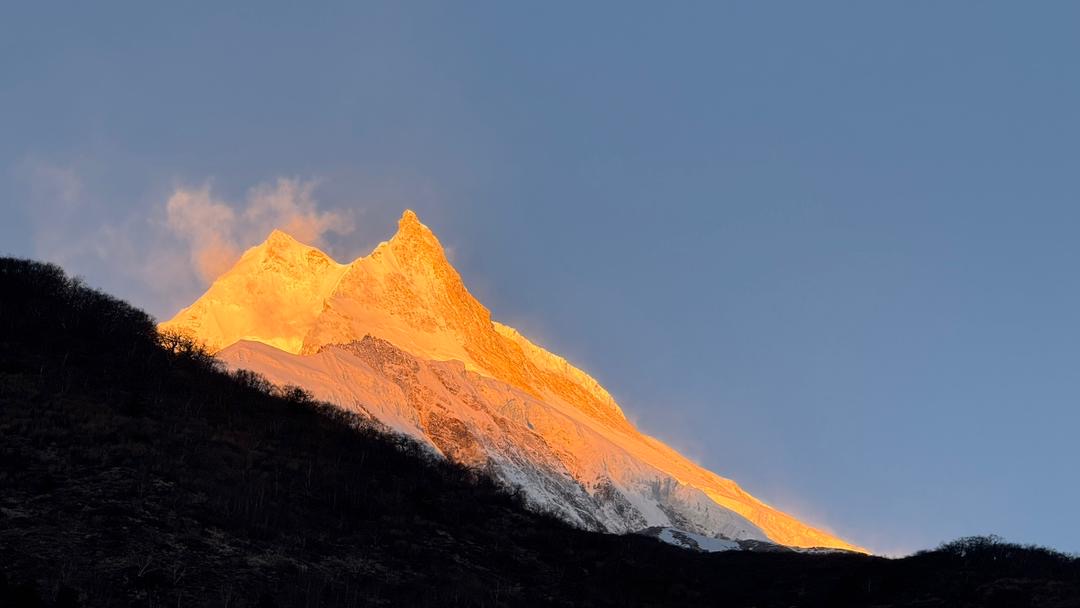
Manaslu Circuit Trek is certainly one of the most rewarding trekking adventures in Nepal that will take you around the eighth-highest mountain in the world, namely Manaslu (8,163 m). The trail crosses remote villages, dense forest, suspension bridges and deep river valleys, ancient monasteries, and high alpine landscapes over a period of more than 15 days, leading to the crossing of a spectacular Larkya La Pass (5,106 m).

The Manaslu Circuit is less crowded and provides a true experience of trekking as compared to Everest and Annapurna regions. You will also get the chance to meet the Gurung and Tibetan communities and experience their unique culture and see awesome views of Mount Manaslu, Himalchuli, Ngadi Chuli, Ganesh Himal, Shringi Himal and Cheo Himal en route.

The trip starts with a nice ride from Kathmandu to Machha Khola and then through the traditional mountain villages to go across Larkya La Pass and finally to Bhimthang and Tilije. The hike offers excellent opportunities for stunning vistas of the mountains, cultural experiences created by the locals and an alternative experience to visiting the often overcrowded Himalayas.

Itinerary

Day 1: Arrival in Kathmandu

Upon arrival you'll be greeted warmly by our representative at Tribhuvan International Airport and taken to your Kathmandu Hotel. After you have checked in you can just sit and relax, or take some time to explore the local area of Thamel, one of the most popular tourist areas of the city. Your trekking guide will meet you in the afternoon for a short orientation on the Manaslu Circuit Trek and to provide you with necessary information on the tour ahead and answer any questions you may have.

  • Max Elevation: 1,400 m
  • Travel Time: Approximately 30–45 minutes from the airport
  • Accommodation: Hotel in Kathmandu
  • Meals: Not Included 
Day 2: Preparation of Manaslu Restricted Area permit and trek briefing

It is the day to make the final preparations for Manaslu Circuit Trek. Our staff will make all the preparations for the Manaslu Restricted Area Permit along with other mandatory permits. You can check trekking gear, rent or buy any missing gear and gear up for the trek during the processing of permits.

There will also be a guided sightseeing tour to visit some of the famous cultural and historical sites in Kathmandu Valley. Your guide will give you an in-depth trek brief in the afternoon or evening, which will include information on the route, day schedule, altitude, safety and more. 

  • Max Elevation: 1,400 m
  • Travel Distance: Approximately 15–25 km
  • Travel Hours: Approximately 4–6 hours
  • Accommodation: Hotel in Kathmandu
  • Meal: Breakfast 
Day 3: drive from Kathmandu to Machha khola

The Manaslu trek starts in the early morning from Kathmandu to Machha Khola. The route goes first along the Trishuli River, then along the Prithvi Highway till the Budhi Gandaki Valley where one turns on a mountain road. On the way, you will visit green hills, terraced farms, rivers, waterfalls and small villages, which will bring a picture of the rural life in Nepal with you. Once in the Manaslu region, the road transforms into uneven and rough terrain, followed by, even more breathtaking surroundings. You will reach the riverside village Machha Khola after a long day of drive and will spend your first night here before you begin your trek.

  • Max Elevation: Approximately 930 m
  • Travel Distance: Approximately 160 km
  • Travel Hours: Approximately 8–9 hours by drive
  • Accommodation: Teahouse/Lodge
  • Meal: Breakfast, Lunch and Dinner 
Day 4: Trek to Jahat

Your first day of trekking passes through forests, rocky paths and small traditional villages, along the Budhi Gandaki River after leaving Machha Khola. The path involves crossing several suspension bridges as you follow the trail till Khorlabesi and finally arrive at Tatopani with natural hot springs near it. From here it follows narrow river-gorges, waterfalls and terraced cultivation with lovely views of the surrounding hills. You will pass along the Budhi Gandaki River a few times on the way to the stone steps leading to Jagat. In this, a very beautiful stone paved village, trekking permits are checked and it is the official entry to the Manaslu Conservation Area. Racetracks by the houses, flags used for prayers and the nature of the mountains provide a calm start for a rich cultural and nature experience at Jagat.

  • Max Elevation: Approximately 1,340 m
  • Travel Distance: Approximately 22 km
  • Travel Hours: Approximately 6–7 hours of trekking
  • Accommodation: Teahouse/Lodge
  • Meal: Breakfast, Lunch and Dinner 
Day 5: Trek to Deng

This day's walk leads deeper into the Manaslu region passing through forests, thin valleys and some villages of the traditional mountain areas. It goes through Salleri, Sirdibas, Philim, Ekle Bhatti, and Bihi Phedi where you can witness the everyday life of the Gurung and Tibetan folks. You will pass through many suspension bridges, step on to sharp cliffs and pass by waterfalls, bamboo forests, pine trees, etc. The landscape slowly shifts and the thrills of Tibetan culture start to become evident as you climb and climb; mani walls, chortens and the clothing of people offering prayer become more prominent along the route. Once through the sublime forest, you will arrive in Deng, a peaceful village. Deng is comfortable being nestled among forests and mountains as it is a base camp before embarking on another trek into the high Himalayas.

  • Max Elevation: Approximately 1,860 m
  • Travel Distance: Approximately 19 km
  • Travel Hours: Approximately 6–7 hours of trekking
  • Accommodation: Teahouse/Lodge
  • Meal: Breakfast, Lunch and Dinner 
Day 6: trek to Namrung

This scenic trek passes through the forests of pine trees and bamboo and along the Budhi Gandaki river past Deng. There are multiple suspension bridges and the tourist passes through the small villages such as Rana and Bihi before arriving at Ghap, a traditional Tibetan village in the midst of wonderful forests. En route, you can see colourful prayer flags along the trail, mani walls and chortens to demonstrate the rich Buddhist culture in the region. The views gradually improve from thick forests to more bare, mountainous terrain as you climb onwards. You will get your first glimpse at Mount Manaslu and other far away peaks in the clear days. Artist's rendition of Namrung village by afternoon, you will arrive in the beautiful traditional village of Namrung, which offers excellent views of the mountains, friendly residents and stone houses. Of the villages on the route, it is one of the largest and great stop over before ascending into the higher part of the Himalayas.

  • Max Elevation: Approximately 2,630 m
  • Travel Distance: Approximately 19 km
  • Travel Hours: Approximately 6–7 hours of trekking
  • Accommodation: Teahouse/Lodge
  • Meal: Breakfast, Lunch and Dinner 
Day 7: Trek to Lho

After visiting the villages of Namrung the road goes through the villages of Lihi and Sho, before the prayer wheels and traditional Tibetan houses and cropped fields with the mountain views. As you ascend, the views get better and better: Mount Manaslu looks as if it were very near as does Himalchuli, Ngadi Chuli and the Ganesh Himal. The trail is maintained and leads towards the peaceful village of Lho through forests, open hillsides and small streams. You will be able to visit the Ribung Monastery among the many attractions of this beautiful village, which is one of the oldest in the region. From here, you then get the fantastic sunset views of Mount Manaslu looming over the village, making Lho one of the most memorable spots to spend an overnight trekking period.

  • Max Elevation: Approximately 3,180 m
  • Travel Distance: Approximately 11 km
  • Travel Hours: Approximately 4–5 hours of trekking
  • Accommodation: Teahouse/Lodge
  • Meal: Breakfast, Lunch and Dinner
Day 8: Trek to Samagaon

As you continue along the trail, you enter forests and alpine areas as you depart from Lho. Following this 30 minute walk you will reach one of the best vantage points on the hike – Shyala. Vested by immense mountains, it is an ideal spot to view Mount Manaslu, Himalchuli, Ngadi Chuli, Peak 29 and other snow capped mountains. The path comes from Shyala, crosses open yak grazing fields, then reaches at the big village of Samagaon. It is a traditional Tibetan settlement, located under Mount Manaslu, and is a significant rest point. Once you have reached a room in the teahouse you can wander around the village, visit neighbouring monasteries, get a feel for the local culture, or simply chill out while enjoying the breathtaking mountains.

  • Max Elevation: Approximately 3,530 m
  • Travel Distance: Approximately 8 km
  • Travel Hours: Approximately 3–4 hours of trekking
  • Accommodation: Teahouse/Lodge
  • Meal: Breakfast, Lunch and Dinner 
Day 9: Acclimatization Day at Samagaon -Birendra lake or Pugen Monastery or Manaslu Base Camp

This is a crucial acclimatisation day where you can relax and get accustomed to the higher altitude prior to the crossing of Larkya La Pass. Rather than spend an entire day in the lodge, guests will walk to one of the close by viewpoints. You can enjoy the beautiful Birendra Lake, visit the peaceful Pungyen Monastery or hike towards Manaslu BC and enjoy even more amazing mountain views as per your fitness level and weather. During the day, rest and enjoy the mesmerizing panoramic sight of Mount Manaslu, glaciers and neighbouring peaks of the Himalaya from the close distance. After spending some time exploring the area you head back to Samagaon for another night's sleep, before getting ready to make the ascent to the higher sections of the trek.

  • Max Elevation: Up to 4,800 m (Manaslu Base Camp hike)
  • Travel Distance: Approximately 6–12 km (depending on the hike)
  • Travel Hours: Approximately 3–7 hours
  • Accommodation: Teahouse/Lodge
  • Meal: Breakfast, Lunch and Dinner 
Day 10: Trek to Samdo

On reaching Samagaon after breakfast you will head en route to the remote village Samdo. Today's walk is of a shorter distance but because of the higher elevation it sets a requirement to walk slow and steady. Stretching along a wide river valley, the trail passes through open valleys, up into alpine meadows and over yak herds. While trekking you will have beautiful scenic view of Mount Manaslu, Simnang Himal, Samdo peak and the several snow covered mountains along the way. However, approaching Samdo, you can see that the landscape is arid and hilly to start with and there are less trees and more rocky hillsides. Close to the Tibetan border is the last permanent village of Samdo before Larkya la Pass. Once you reach the summit be sure to pause, wander through the village and enjoy the quiet mountain environment while gearing up for the rest of the hike.

  • Max Elevation: Approximately 3,875 m
  • Travel Distance: Approximately 8 km
  • Travel Hours: Approximately 3–4 hours of trekking
  • Accommodation: Teahouse/Lodge
  • Meal: Breakfast, Lunch and Dinner 
Day 11: trek to Larkya Phedi ( Dharmshala )

Once more you venture higher in the picturesque terrain of the high Himalayas to climb to the next point of interest – Larkya Phedi or Dharamshala. The path gradually ascends through the rocky trackways, glacial streams, and open valleys, enjoying stunning scenery of the mountains around them. On the way, you'll cross numerous wooden bridges (many man-made) while visiting old mani walls and praying flags. There is an increase in the thickness of the vegetation with its dramatic environment, as the altitude goes up. It is a small settlement created to provide respite for trekkers heading up to Larkya La Pass. Once there, you'll have the chance to take it easy, appreciate the mountain views, and get ready for an adventurous day tomorrow. A good night's sleep is advised; the day of training is to start before sunrise.

  • Max Elevation: Approximately 4,460 m
  • Travel Distance: Approximately 7 km
  • Travel Hours: Approximately 4–5 hours of trekking
  • Accommodation: Teahouse/Lodge
  • Meal: Breakfast, Lunch and Dinner 
Day 12: Trek to Bhimthang via Larkya La pass

This is the longest day and the most rewarding day of the Manaslu Circuit Trek. The journey will begin early in the morning and can be a fairly steep climb up to Larkya La Pass (5,106 metres) the highest point of the trek. The trail passes through rocks, glacial moraines and snow fields to the colorful prayer flags at the top of the mountain. From the pass you will have spectacular panoramic views of Mount Manaslu, Himlung Himal, Cheo Himal, Kang Guru, Annapurna II and many others. This will take you to the pass and then turn back to descend through glacial valleys to Bhimthang through alpine meadows. Enclosed by mountains and the grasslands, Bhimthang is one of the most picturesque overnight campsites along the entire trail.

  • Max Elevation: 5,106 m (Larkya La Pass)
  • Travel Distance: Approximately 24 km
  • Travel Hours: Approximately 8–10 hours of trekking
  • Accommodation: Teahouse/Lodge
  • Meal: Breakfast, Lunch and Dinner 
Day 13: Trek to Tiliche

Today's trek is mostly downhill, through beautiful forest and peaceful valleys, after the challenging pass crossing. The walk continues on through the alpine meadows, then into thick forests of pine, rhododendron and oak, leaving Bhimthang behind. There is a small village named Gho passing through which has a wooden bridge over the Dudh Khola river, across the river is a suspension bridge and is a small village named Karche where you can witness the traditional stone houses and farms. The milder weather and more fertile environment make an enjoyable break from the high altitudes on the way down. You will reach the traditional village of the Gurungs, Tilije by the afternoon of day 5 from where you can rest and enjoy the culmination of the most difficult of days on the trek.

  • Max Elevation: Approximately 3,720 m
  • Travel Distance: Approximately 19 km
  • Travel Hours: Approximately 6–7 hours of trekking
  • Accommodation: Teahouse/Lodge
  • Meal: Breakfast, Lunch and Dinner 
Day 14: Drive Back to Besisahar

This morning you take a journey from Tilije to Besisahar, on jeeps. The road ascends up the hills and passes through lovely valleys, rivers, forests and typical villages until it merges into the main road. Venturing along you'll see a lot of terraced farmland, waterfalls and the hills around you as you step out of these high mountains progressively. Besisahar, the District headquarter of Lamjung comes after 7-8 hours of travelling. In this place you can have a soothing night, contemplate your trekking journey and commemorate your triumph round Mt Manaslu.

  • Max Elevation: Approximately 2,300 m (Tilije)
  • Travel Distance: Approximately 65 km
  • Travel Hours: Approximately 5–6 hours by jeep
  • Accommodation: Hotel/Lodge
  • Meal: Breakfast, Lunch and Dinner 


Day 15: Drive to Kathmandu

Post breakfast, you will take the return journey to Kathmandu back on the Prithvi Highway. The route meanders through small towns, green hills, terraced fields and rural villages, along the Marshyangdi and Trishuli Rivers. On the way you will discover the beauty that changes with the seasons, before reaching the bustling capital once again. You will go to Kathmandu where you will be picked up by taxi for your hotel. The remainder of the day is free to shop, relax or explore the city before traveling further. At the end of the day, kick off the offer of your life-changing Manaslu Circuit trek and reminisce about your trekking experience.

  • Max Elevation: 1,400 m (Kathmandu)
  • Travel Distance: Approximately 175 km
  • Travel Hours: Approximately 6–7 hours by drive
  • Accommodation: Hotel in Kathmandu
  • Meal: Breakfast 

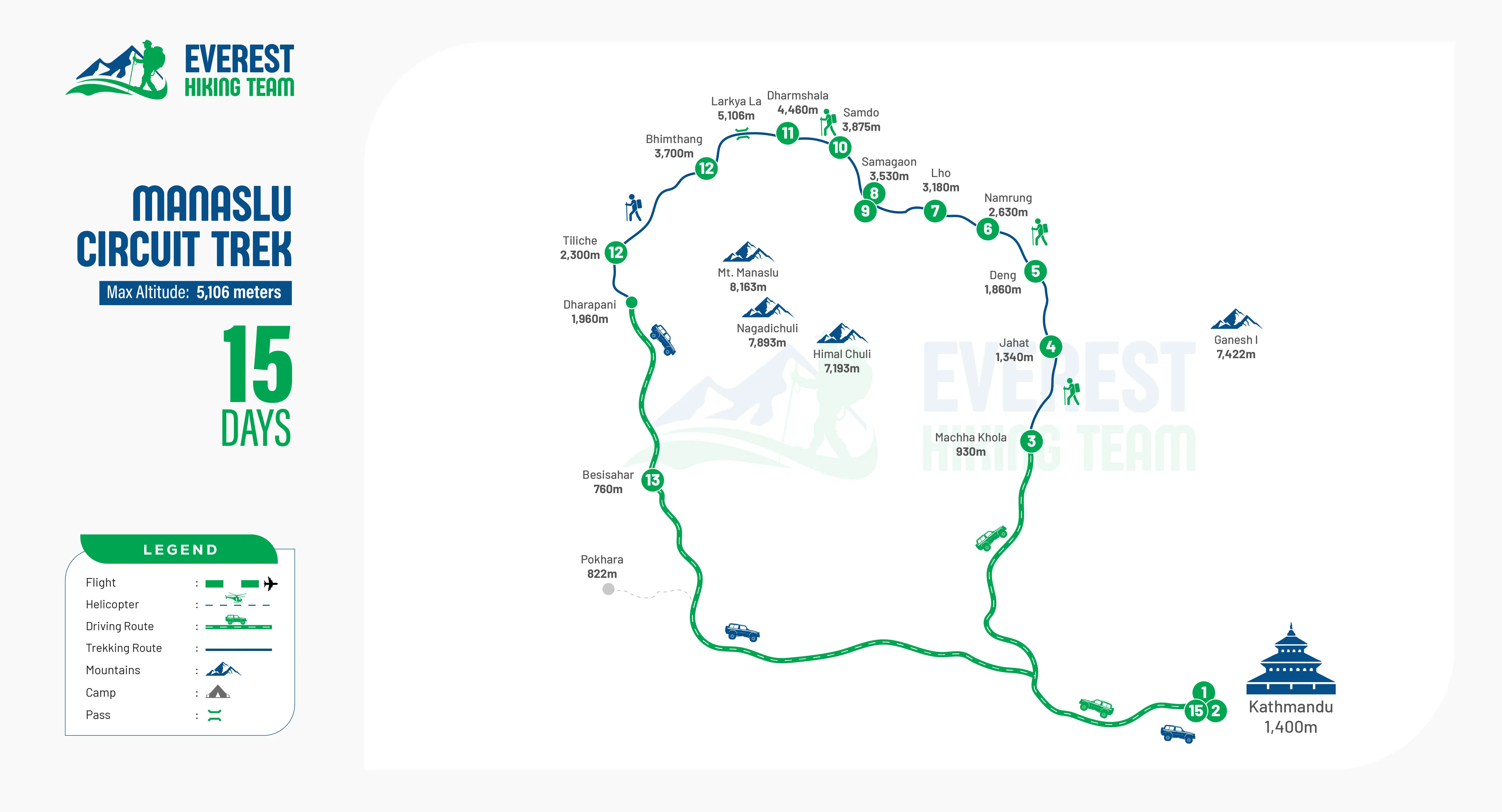
Trek Route

Manaslu Circuit Trek-15 days route image

What's included

  • Airport Pickup/Drop off by private vehicle.
  • 3 nights Hotel in Kathmandu on a twin sharing basis with breakfast.
  • Welcome Dinner.
  • Three meals a day during the trek (Breakfast, Lunch, Dinner with the 3 cup of tea/coffee per day)
  • Each evening fresh fruit offered after dinner during trek.
  • Basic teahouse/trekking lodge accommodation all along the trek.
  • A qualified and competent English speaking and government approved trekking guide.
  • The salary, meals, accommodation, transport, equipment and insurance for the guide and porter.
  • Each 2 trekkers have 1 good and experienced porter.
  • The cost of the Guide and porter, meals, accommodation, transport, equipment and insurance.
  • Small group (assistant) guide–for over six trekkers.
  • * All required trekking permits for the Manaslu Circuit Trek.
  • Private jeep service by jeep from Kathmandu to Machha Khola.
  • Private jeep ride from Tiliche to Besisahar to Kathmandu.
  • A kit of first- aid supplies and basic medicines for the hiking.
  • Providing emergency helicopter evacuation, if necessary. You must have travel insurance to pay this evacuation cost.
  • Oximeter to monitor your oxygen level, pulse and/or heart rate during the hike. These checks are usually done twice a day to help monitor symptoms of altitude sickness.
  • Guaranteed accommodation in Kathmandu with free luggage storage facilities for the luggage that will not be used for the trekking.
  • Government taxes, service charges, and other official expenses.

What's excluded

  • Lunch and Dinner  in Kathmandu.
  • Entry visa price to Nepal. There is currently a USD 50 fee for a 30-day on-arrival visa.
  • International airfare.
  • Travel insurance, trekking and emergency medical insurance. Travel insurance required.
  • Personal expenditures, like candy, mementoes etc. items bought individually.
  • Others types of alcoholic beverages and extras hot or cold drinks.
  • The entrance fee to the sightseeing and monuments of Kathmandu is around USD 30 per person.
  • Personal use of laundry service, use of the telephone and the Internet.
  • Personal trekking gear and equipment.
  • There is a charge for hot shops and charging batteries in teahouses.
  • Tips for guide, porter and driver.
  • Micro spikes and gaiters must be worn on all year round and are available to rent—there are no fee charged or payment required required.

Packing List

Packing for the Manaslu Circuit Trek is crucial as the climate and the temperatures vary depending on a trek at higher altitudes. High altitudes and mornings or evenings can be very cold and lower sections of trail can be hot during the day. Pack warm layers, comfortable trekking clothes, good boots as well as personal items and essentials. Pack Light and Use only what is necessary as a trekking bag will be taken by the porter. A daypack should include  important items like water, snacks, sunscreen, rain jacket and any personal medications.

Clothing

  • Lightweight trekking shirts
  • Long-sleeved trekking shirts
  • Trekking trousers
  • Warm fleece or insulated jacket
  • Waterproof and windproof jacket
  • Waterproof trekking trousers or rain pants
  • Thermal base layers for cold weather
  • Warm trousers or insulated pants
  • Comfortable clothes for the evening
  • Underwear
  • Trekking socks
  • Warm wool socks
  • Warm hat or beanie
  • Sun hat or cap
  • Lightweight gloves
  • Warm insulated gloves
  • Neck gaiter or scarf

Footwear

  • Waterproof trekking boots with good ankle support
  • Comfortable shoes or sandals for the evening
  • Lightweight slippers for use inside the teahouse
  • Gaiters to protect your boots and lower legs from snow, mud, and dust
  • Microspikes for walking safely on icy or snowy trails

Trekking Equipment

  • Backpack or duffel bag for your main luggage
  • Small daypack for daily essentials
  • Rain cover for your backpack
  • Trekking poles
  • Sleeping bag suitable for cold temperatures
  • Headlamp with extra batteries
  • Reusable water bottles or a hydration bladder
  • Water purification tablets or a water filter
  • Sunglasses with UV protection
  • Quick-drying trekking towel
  • Dry bags or waterproof bags for clothes and electronics
  • Small padlock for your luggage

Personal and Toiletry Items

  • Toothbrush and toothpaste
  • Soap or biodegradable body wash
  • Shampoo
  • Hand sanitiser
  • Wet wipes or tissues
  • Toilet paper
  • Sunscreen with high SPF
  • Lip balm with sun protection
  • Moisturiser
  • Small mirror
  • Comb or hairbrush
  • Nail clippers
  • Personal hygiene products

First-Aid and Personal Medication

  • Personal medication with a prescription, if needed
  • Pain relief medicine
  • Medicine for diarrhoea or stomach problems
  • Blister plasters or blister treatment
  • Antiseptic cream
  • Bandages and small medical tape
  • Cold and cough medicine
  • Oral rehydration salts
  • Any medicine recommended by your doctor

Important Documents

  • Passport
  • Nepal visa documents, if required
  • Travel insurance details
  • Travel insurance that covers trekking at high altitude and emergency helicopter evacuation
  • Passport-sized photographs
  • Copies of your passport and insurance documents
  • Cash in Nepalese rupees for personal expenses
  • Emergency contact information

Optional Items

  • Camera and charger
  • Power bank
  • Extra memory card
  • Travel adapter
  • Earplugs for noisy teahouses
  • Eye mask
  • Books, cards, or a journal
  • Snacks such as energy bars, chocolate, or nuts
  • Small binoculars
  • Lightweight trekking umbrella
  • Laundry soap or detergent sheets
  • Small sewing or repair kit

Frequently Asked Questions

1. How difficult is the Manaslu Circuit Trek?

The Manaslu Circuit Trek is considered a moderate to challenging trek because of three reasons; one is the long and arduous walking days, the other is the high altitude and steep uphill and downhill paths. The trek reaches its highest point at Larkya La Pass, which is 5,106 metres above sea level. No previous high altitude trekking experience needed, however good fitness, exercise regimes and preparation is important.

2. What is the best time to do the Manaslu Circuit Trek?

The best time to plan a Manaslu Circuit Trek is in either the spring/March to May period, or the autumn/September to November pass. These months are generally dry and have fairly settled conditions with relatively benign weather and clear mountain views, allowing for fairly comfortable trekking. The seasons are cold and snowy during the winter, rain falls in the monsoon and those trails get muddy and landslides are more likely.

3. Do I need a permit for the Manaslu Circuit Trek?

Yes, permits are needed as the Manaslu area is a restricted region. Typically visitors have to obtain a Manaslu Restricted Area Permit, Manaslu Conservation Area Permit and Annapurna Conservation Area Permit. Note: Must be guided by a registered guide and the permit to access the restricted area must be booked through a licensed trekking company!

4. Is there a risk of altitude sickness during the trek?

Yes, trekkers can suffer from altitude sickness on the trek as the path slowly rises above 5000 metres at Larkya LA Pass. Acclimation day (1 day) at Samagaon to settle in at higher altitude. Slowly, drink adequate fluid and let your guide know of any signs of discomfort to help decrease the risk.

5. What kind of accommodation and food are available during the trek?

The main lodging on the road will be in basic teahouses or trekking lodges. Rooms tend to be plain and frequently shared with others, particularly at higher levels. Teahouses serve basic dishes like dal bhat, noodles, rice, soup, potato, egg and other basic food.

User Review