Makalu Base Camp Trek-17 Days

Tour Info

Trip code

E-015

Starting Point/ End Point

kathmandu

Accommodations

Lodge/Tea House

Max Altitude

4870m

Duration

17 days

country

Trip grade

Moderate

Best Season

Spring (March–May) and Autumn (September–November)

Highlights

  • Arrive in Makalu base camp at the height of 4,870 m.
  • Stun with views of the majestic Mt Makalu, Mt Everest, Lhotse, Chamlang and Baruntse.
  • Walk in the farthest and stunning Makalu Barun National Park.
  • Cross Shipton La's pound-in pound-out mountain pass section.
  • Go for a walk through the rhododendron, pine and alpine forests.
  • Visit Barun Valley, a remote and beautiful valley.
  • Visit typical Sherpa and Rai villages and experience Sherpa culture in the mountains.
  • Spend a less crowded trek in the off-beat areas of Everest and Annapurna routes.
  • Hike around Makalu Base Camp and get glimpses of the glaciers and peaks of the Himalayas.

Overview

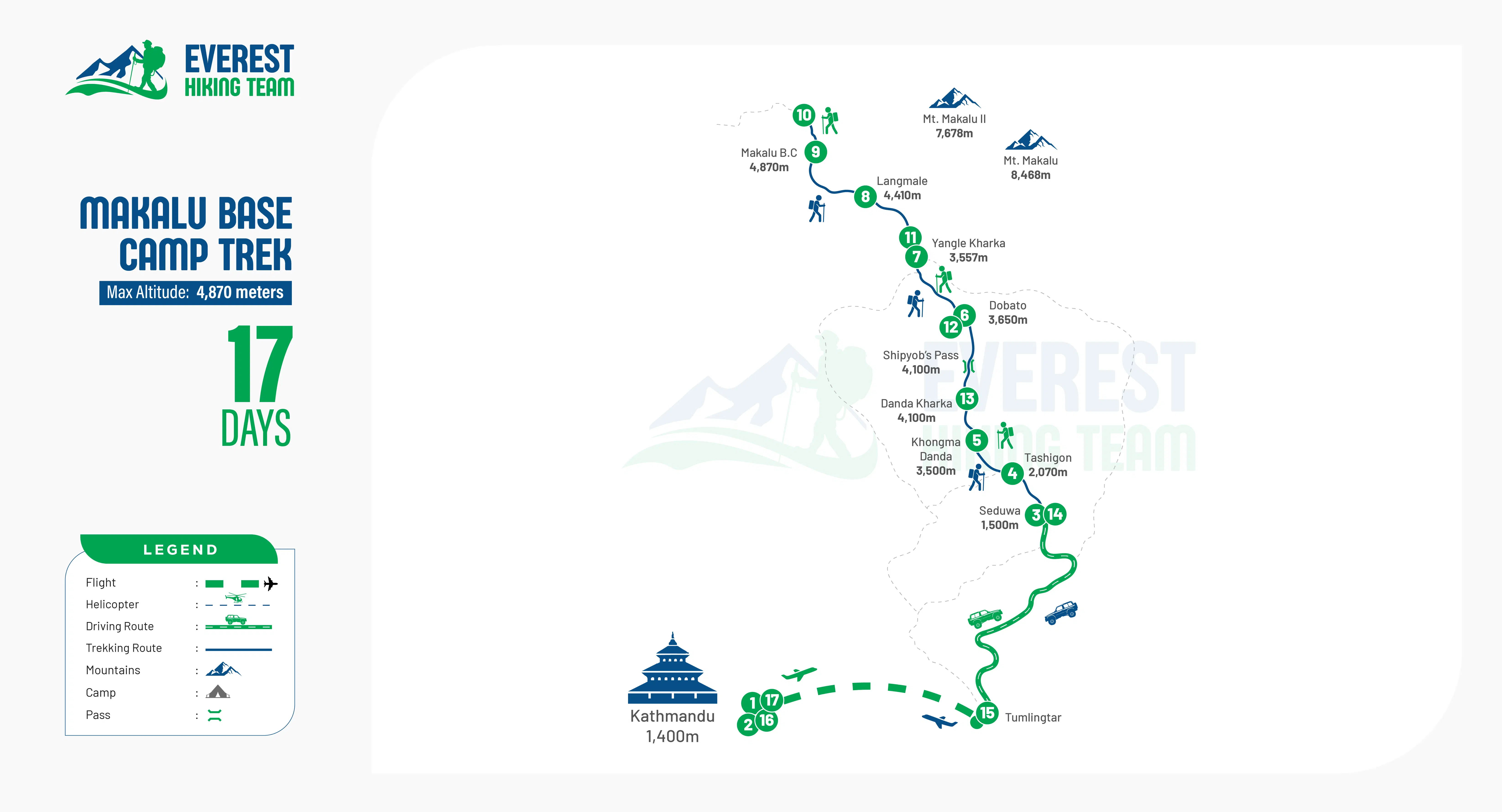
Makalu Base Camp Trek is a trek of challenge and achievement through one of the most ancient kingdom of Nepal's most far-flung regions. The route wanders through Makalu Barun National Park, lovely mountain villages, green woods, high passes and alpine meadows and the out-of-the-way Barun Valley. The journey starts off with a scenic flight from Kathmandu to Tumlingtar, before being continued by a trek up to Seduwa. Then, the trail slopes up through Tashigaon, Khongma Danda, Dobato, Yangle Kharka and Langmale Kharka, finally reaching a height of 4,870m at Makalu Base.

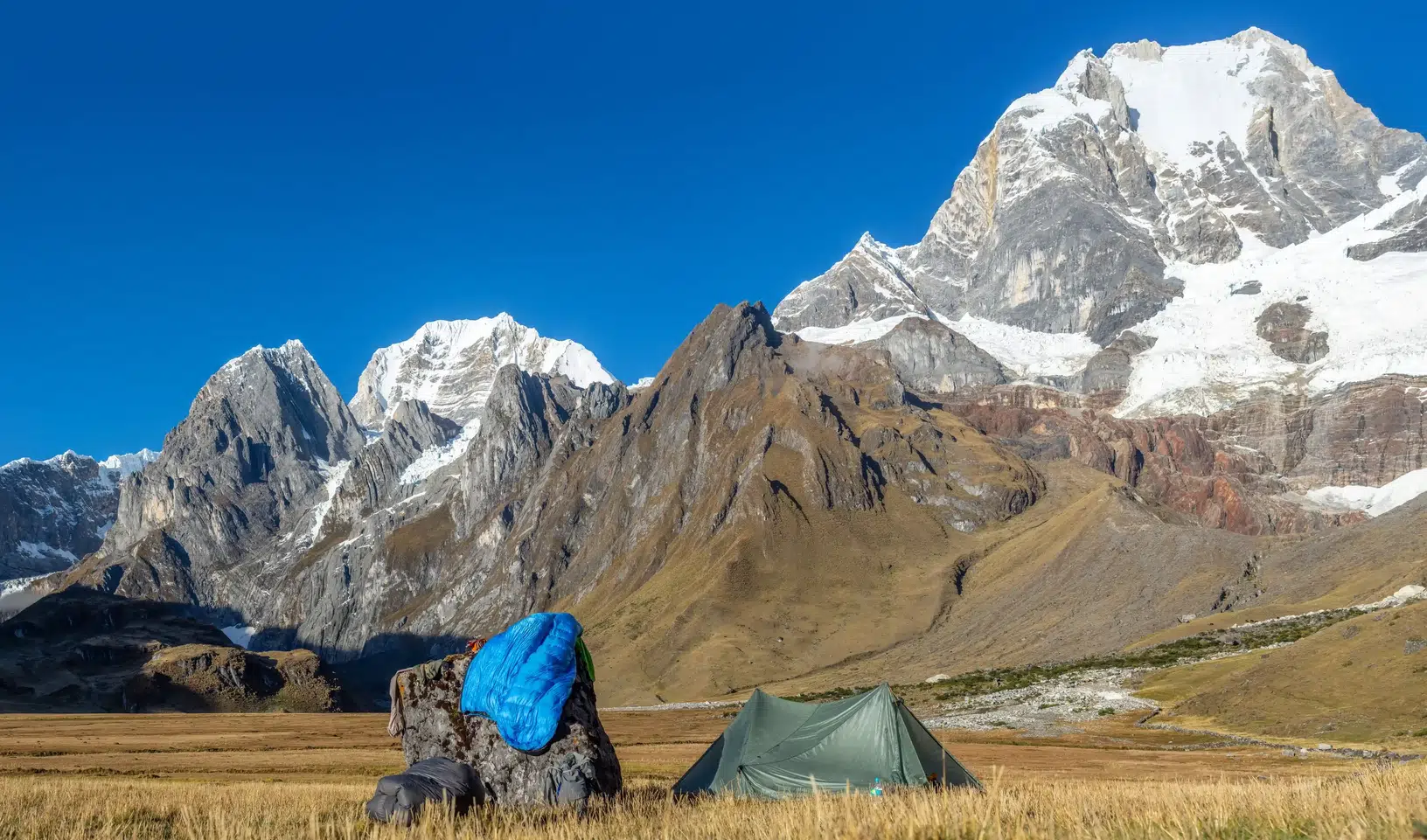
Along the way, you can enjoy spectacular views of Mount Makalu, the world's fifth-highest mountain, as well as Everest, Lhotse, Chamlang, Baruntse, and other Himalayan peaks. Steep walks, long days in the boot, high passes, and long days in the backcountry make this trek ideal for well-trained and fit walking expeditions with some experience on mountain trails.

Itinerary

Day 1: Arrival Kathmandu

Welcome to Nepal! On your arrival at Tribhuvan International Airport, we will meet you and drive you to your hotel in Kathmandu. You can also take a break afterwards, to recuperate from your trip. If you have enough time, you can explore the nearby streets of Kathmandu or simply relax at the hotel. This day is set up as an easy day, to prepare yourself for the hard day.

  • Max Elevation: 1,400 m
  • Travel Distance: Approximately 6 km by road
  • Travel Hours: Approximately 30 minutes
  • Accommodation: Hotel in Kathmandu
  • Meal: Breakfast 
Day 2: Preparation for the Makalu Trek and trek briefing

The day today is spent preparing for our Makalu Base Camp Trek. You will get an extensive explanation from your trekking guide of the route and walking conditions, the altitude of the trek, safety measures and what you may encounter along the way.

A chance will also be given to you to inspect your trekking gear and/or do any final preparations. This prep day is crucial as the journey to the Makalu region is a long one with long walking days, and is a remote trek and involves high altitude ascents.

  • Max Elevation: 1,400 m
  • Travel Distance: Minimal
  • Travel Hours: As required for preparation
  • Accommodation: Hotel in Kathmandu
  • Meal: Breakfast 
Day 3: Flight to Tumlingtar + Drive to Seduwa

The flight time to the remote Makalu area is first on a scenic flight from Kathmandu to Tumlingtar. Outside the Kathmandu Valley, one can have a glimpse of the hills, valleys, rivers, and the distant mountains of the Himalayas of Nepal.

On arrival at Tumlingtar, you'll take to the road for Seduwa. Seduwa is the gateway to the Makalu region and marks the official entry point to Makalu Barun National Park. The drive takes you through the rural areas, green hills and twisting mountain trails. Seduwa is the starting point for the trekking section therefore the night is to be spent here before you start your trek to the Makalu Region.

  • Max Elevation: Approximately 1,500 m
  • Travel Distance: Approximately 100 km by road
  • Travel Hours: Approximately 4 to 6 hours of driving, plus the flight
  • Accommodation: Teahouse or lodge in Seduwa
  • Meals: Breakfast, Lunch, and Dinner 
Day 4: Trek to Tashigon

The first challenging day of the trek takes you from Seduwa to Tashigaon. As you slowly ascend, the route winds through the still villages and terraced fields, forests and hillsides. There is some uphill climbing along the trail but it is a peaceful stroll to enjoy all the beauty it has to offer. When you enter Tashigaon, you start to see the traditional lifestyle which existed in the mountains of this region. Tashigaon is also part of the important settlements along the way, and offers a nice resting place before ascending into the mountains.

  • Max Elevation: Approximately 2,070 m
  • Travel Distance: Approximately 12 km
  • Travel Hours: Approximately 4 to 5 hours of trekking
  • Accommodation: Teahouse or lodge in Tashigaon
  • Meals: Breakfast, Lunch, and Dinner 
Day 5: Trek to Khongma Danda

Today, the path starts climbing uphill from Tashigaon to Khongma Danda; the path becomes steeper. The way flows through gorgeous forests, and as it gradually climbs in the future, the trail grows rougher.

The hike is steep on some of the stone steps and is uphill, which can be exhausting. As one ascends to the level above the surrounding valleys, however, the views get increasingly better. Finally, you will arrive at the important post of Khongma Danda after an hour or more hike which is a stepping stone to cross the high passes in route to Makalu Base Camp.

  • Max Elevation: Approximately 3,500 m
  • Travel Distance: Approximately 9 km
  • Travel Hours: Approximately 5 to 6 hours of trekking
  • Accommodation: Teahouse or lodge in Khongma Danda
  • Meals: Breakfast, Lunch, and Dinner 
Day 6: Trek to Dibato Via Shipyob’s Pass

This is one of the most difficult hikes of the Makalu Base Camp Trek. There are a number of very steep ascents and descents along the way and the trail passes through a high pass area called Shipton La.

As you climb higher, the landscape changes from thick forests to open mountain terrain. Your journey will go over a number of passes and walking through a rough landscape with views of the surrounding hills and mountain peaks such as Mount Everest, Lhotse, and Makalu. The difficult section of the pass is completed and then it heads towards Dobato for your overnight stop.

  • Max Elevation: Approximately 4,100 m
  • Travel Distance: Approximately 10 to 12 km
  • Travel Hours: Approximately 6 to 8 hours of trekking
  • Accommodation: Teahouse or lodge in Dobato
  • Meals: Breakfast, Lunch, and Dinner 
Day 7: Trek to Yangle Kharka

On the day, you will depart from Dobato and head north to Yangle Kharka. The trail winds through forests, rock outcrops, small streams and open mountain views. Today the route gently descends to the Barun Valley after crossing challenging high river crossings the night/day before.

The land turns green and the air becomes more pleasant the lower they go. The trail is in remote and quiet wilderness where there are very few settlements along the way. You will eventually come to the peaceful mountain pasture of Yangle Kharka amidst the forests, the hills and the natural beauty of the Makalu region. 

  • Max Elevation: Approximately 3,557 m
  • Travel Distance: Approximately 12 to 14 km
  • Travel Hours: Approximately 5 to 7 hours of trekking
  • Accommodation: Teahouse or lodge in Yangle Kharka
  • Meals: Breakfast, Lunch, and Dinner 
Day 8: Trek to Langmale

The hike traces its course further into the far edges of the Barun valley today, heading towards Langmale Kharka. The trail passes through forests, open fields, stone fields and mountains.

Landscape starts to look different as you gradually climb higher. Forest density declines and topography opens up and becomes more alpine. The mountains also look closer as you venture into the high Himalayas. It's a relatively steady, scenic walk, however as the elevation rises it is important to moderate the pace and pay attention to time spent on this walk. Finally, after a few hours of walking, you will arrive at Langmale Kharka, a significant resting point leading to Makalu Base Camp.

  • Max Elevation: Approximately 4,410 m
  • Travel Distance: Approximately 10 to 12 km
  • Travel Hours: Approximately 5 to 6 hours of trekking
  • Accommodation: Teahouse or lodge in Langmale Kharka
  • Meals: Breakfast, Lunch, and Dinner 
Day 9: Trek to Makalu Base Camp

One of the pivotal days of the hike to Makalu Base Camp is today. The trail winds through the upper Barun valley where the terrain starts to be more rugged and remote. You will be stepping into the rocks and open mountain views, as well as glaciers, high cliffs and snow-covered peaks all the way. The views get breathtaking as you ascend further; the highlight is the looming Mount Makalu and other peaks surrounding it.

After a long and rewarding trek, you will finally arrive at Makalu Base Camp at a height of some 4,870 metres. The base camp offers a stunning view of Mount Makalu, along with Himalayan cliff faces and ranges. 

  • Max Elevation: 4,870 m
  • Travel Distance: Approximately 12 to 15 km
  • Travel Hours: Approximately 6 to 7 hours of trekking
  • Accommodation: Teahouse or lodge at Makalu Base Camp
  • Meals: Breakfast, Lunch, and Dinner 
Day 10: Hike to Viewpoint and explore Makalu Base Camp

Today is dedicated to an exploration of the amazing scenery to be found at Makalu Base Camp. Once at the base camp you will be able to relax through the spectacular scenery that surrounds the mountain, the glaciers and rock formations.

If the weather and your health permit it, you can take a short hike to a nearby viewpoint that offers you greater views of the surrounding mountains. The main attraction of the landscape is Mount Makalu and the surrounding peaks and glaciers are also impressive. It's also a wonderful day for a photo shoot, relaxation and a night of rest prior to the start of the onward journey. Depending on weather and trail conditions, this can be viewed from a different angle and hiked from a different spot. 

  • Max Elevation: Approximately 5,000 m or higher, depending on the viewpoint
  • Travel Distance: Approximately 5 to 8 km of hiking
  • Travel Hours: Approximately 3 to 5 hours
  • Accommodation: Teahouse or lodge at Makalu Base Camp
  • Meals: Breakfast, Lunch, and Dinner 
Day 11: Trek down to Yangle Kharka

After spending time at Makalu Base Camp, you will begin your return journey through the Barun Valley. The path retracks back towards Yangle Kharka, by a remote path. Although you have already walked this route, the scenery can look different when travelling in the opposite direction. This will mostly be in rocky mountain conditions and then you will gradually be taken on a descent to the valley bottoms. There's still a long way to go but one needs to keep going at the same pace during the day. As you go lower, the air feels easier to breathe, and the landscape becomes greener.  Eventually at the end of the day you reach Yangle Kharka for a night's rest. 

  • Max Elevation: Approximately 4,870 m at the start
  • Travel Distance: Approximately 15 to 17 km
  • Travel Hours: Approximately 6 to 8 hours of trekking
  • Accommodation: Teahouse or lodge in Yangle Kharka
  • Meals: Breakfast, Lunch, and Dinner 
Day 12: Trek to Dobate

Today, you will continue your return journey towards Dobato. The hiking route slowly heads toward the exit of the Barun Valley through forests, rocky areas and serene mountain scenery. This trail is hilly, it is another challenging day. With the same hills and same ridgerunners, however, it's still a fun trek. It's a gradual ascent towards the more elevated outcrops of the mountain and the middle part of the Barun valley will leave you behind. After several hours of trekking, you will arrive in Dobato, where you can rest and enjoy the evening.

  • Max Elevation: Approximately 4,000 m
  • Travel Distance: Approximately 12 to 15 km
  • Travel Hours: Approximately 6 to 8 hours of trekking
  • Accommodation: Teahouse or lodge in Dobato
  • Meals: Breakfast, Lunch, and Dinner 
Day 13:Trek to Danda Kharka

The trail continues towards Danda Danda today. Depending on the exact trail conditions and route you will again cross the high mountain landscape and pass through the Shipton La pass section. It is somewhat difficult in the day and marked by some very hard climbs and descents en route back. But the journey is made worthwhile by the surrounding mountain peaks, such as Mount Everest, Lhotse, and Makalu, and the feeling of slowly completing the journey.

After Danda Kharka you can get a good night-long sleep and hereafter enjoy the last evening in the high mountain section and head further towards the lower section of the Makalu region. 

  • Max Elevation: Approximately 4,100 m
  • Travel Distance: Approximately 10 to 12 km
  • Travel Hours: Approximately 6 to 8 hours of trekking
  • Accommodation: Teahouse or lodge in Khongma Danda
  • Meals: Breakfast, Lunch, and Dinner 
Day 14: Trek to Seduwa

Today is the start of a long gentle descent back to Tashigon and then all the way down to Seduwa. As the trail descends from the high mountain terrain, you pass through forests and over hilly terrain. Surroundings around you get greener and air gets warmer as you descend. The path goes through scenic natural areas and leads to the lower hills of Makalu area.

From here you will arrive at Seduwa after a lengthy walk. This is the end of the main trekking section on Makalu Base Camp trek allowing you to sit back and savor your last night in the trek area. 

  • Max Elevation: Approximately 3,500 m at the start
  • Travel Distance: Approximately 15 to 18 km
  • Travel Hours: Approximately 6 to 8 hours of trekking
  • Accommodation: Teahouse or lodge in Seduwa
  • Meals: Breakfast, Lunch, and Dinner 
Day 15: Drive to Tumlingtar

At the end of the walk, you will arrive in Seduwa and continue to the road to Tumlingtar. Trails and roads go through the countryside, along green hills, through varying scenery. It is a long drive, and in parts it is rough, but it will give you a chance to take a break after having trekked for several days. The views turn from mountains into greener hills and valleys as you continue along towards the lower portions.

On arriving at Tumlingtar, you will be taken to your room at the hotel and have the opportunity to refresh yourself, and go explore Tumlingtar before the next flight to Kathmandu on the next day. 

  • Max Elevation: Approximately 1,500 m
  • Travel Distance: Approximately 100 km by road
  • Travel Hours: Approximately 4 to 6 hours of driving
  • Accommodation: Tea house or lodge in Tumlingtar
  • Meals: Breakfast, Lunch, and Dinner 
Day 16: Flight to Kathmandu

The route back to Kathmandu from Tumlingtar will be by plane today! On the flight is the last chance to see the hills, valleys and the Himalayas landscapes you have crossed on the trek. Once you have arrived in Kathmandu, you will be picked up in your car and drive to your hotel. For the remainder of the day, you will have free time to enjoy, unwind from the trip, admire the city, do some shopping, or end the day in Nepal.

  • Max Elevation: Approximately 1,400 m
  • Travel Distance: Approximately 400 km by air
  • Travel Hours: Approximately 35 to 45 minutes by flight
  • Accommodation: Hotel in Kathmandu
  • Meals: Breakfast 
Day 17: Final departure

Your Makalu Base Camp Trek comes to an end today. Our representative will transfer you to Tribhuvan International Airport for your last flight based on your flight timings. At the end of this arduous trek in an isolated part of Nepal, you will come out with experiences of high passes, remote valleys, traditional villages, majestic landscapes and magnificent views of Mount Makalu.

  • Max Elevation: Approximately 1,400 m
  • Travel Distance: Approximately 6 km by road
  • Travel Hours: Approximately 30 minutes
  • Accommodation: Not included
  • Meals: Breakfast 

Trek Route

Makalu Base Camp Trek-17 Days route image

What's included

  • Airport pick-up and drop-off by private vehicle.
  • 3 nights hotel in kathamndu.
  • welcome Dinner in Kathmandu.
  • All Meals on the trek: Breakfast, lunch and dinner everyday plus one cup of tea/coffee with meals.
  • Accommodation: Basic teahouse/trekking lodge accommodation along the trekking.
  • Entry Permit: Makalu Barun National Park entry permit and Trekkers' Information Management System (TIMS) card.
  • Flights and airport transfer: Airfare to and from Kathmandu including airport transfer (Kathmandu–Tumlingtar–Kathmandu round trip).
  • Familiar guide: An experienced government-guided (with English) guide. This covers the guide's expenses of salary, meals, accommodation, transport and insurance.
  • Porter service: One porter for every two trekkers. The safety and trekking equipment is provided and the salary, meals, and insurance all included for porters.
  • Medical focal points: Departmental medical management as Focal Point.Safe and sanitary facilities: Providing safe and sanitary facilities. Your travel insurance should be able to cover the cost of rescue.
  • Government taxes and official charges: All Government tax and other official charges that are applicable to the trek.
  • Makalu Base Camp trekking map: A hiking map to assist with the trek.
  • Twice daily health monitoring: Your oxygen saturation level, pulse and heart rate are checked using a machine known as an oximeter, twice a day. This allows the guide to watch for signs and symptoms of altitude sickness as well as the safety of you on the hike!
  • In Kathmandu luggage storage service is available for storing all items which are not needed for the trek.

What's excluded

  • Kathmandu expenses: The costs of meal during stay in Kathmandu (except mentioned in the itinerary) and hotel accommodation in Kathmandu.
  • Nepal visa-on-arrival fee: Nepal admits visitors on a visa on arrival and there is a visa-on-arrival fee of USD 50 for that.
  • Travel insurance: Full travel insurance with an emergency medical coverage and a helicopter for high altitudes is mandatory.
  • International flights: Airfare for visa international Nepal.
  • Personal expenses: Spending on souvenirs, laundry, a snack, personal shopping and other personal expenses.
  • Personal drinks: Alcoholic and non-alcoholic beverages (excluding any provided with meals in the form of tea or coffee).
  • This is where sleeping bag, down jacket and trekking poles can be rented should these items not be in your possession. The purchase charge for the day is a maintenance and cleaning fee of USD 10 per item and all rented equipment is to be returned at the end of the trek.
  • Hot Showers and Charging: Hot showers and battery-charging facilities are offered at the teahouses for an extra fee.
  • Tips for the guide, porters, driver.
  • Excess baggage items: Items that have been overbagged from the airline baggage allowance: 20 kg for Tumlingtar.

Packing List

The primary items on the packing list for the Makalu Base Camp Trek are warm clothing, comfortable trekking gear, protection from the sun and cold, as well as personal effects. It's a trek that will climb to nearly 5000 metres and so you should be ready for changing weather and cold temperatures at higher altitudes. Be careful in packing, but don't take unnecessary things with you, since you'll be able to leave most of your paraphernalia with the porters and just bring a small daypack to use during the trek. Other equipment like a sleeping bag, down jacket and trekking poles can also be rented if necessary.

Makalu Base Camp Trek Packing List Clothing: 

Base Layers

  • 2–3 moisture-wicking T-shirts
  • 1–2 long-sleeved thermal tops
  • 1–2 pairs of thermal leggings or base-layer trousers

Trekking Clothes

  • 2–3 pairs of trekking trousers
  • 1 pair of comfortable hiking shorts or lightweight trousers for lower elevations
  • 1 fleece jacket or warm mid-layer
  • 1 warm down jacket
  • 1 waterproof and windproof jacket
  • 1 pair of lightweight thermal trousers or fleece trousers

Underwear and Sleepwear

  • 4–6 pairs of underwear
  • 3–5 pairs of trekking socks
  • 2–3 pairs of warm wool or thermal socks
  • Comfortable clothes for sleeping

Footwear

  • Comfortable, waterproof trekking boots with good ankle support
  • Lightweight shoes or sandals for use around the teahouse
  • Gaiters, especially for muddy, snowy, or wet trail conditions

Head and Hand Protection

  • Warm woollen hat or beanie
  • Sun hat or cap
  • Buff or neck gaiter
  • Warm gloves
  • Lightweight inner gloves
  • Sunglasses with good UV protection

Sleeping Gear

  • Warm sleeping bag suitable for high-altitude trekking
  • Sleeping bag liner, if preferred
  • Small travel pillow or inflatable pillow

A sleeping bag and down jacket can be rented if you do not have your own. Trekking poles can also be rented.

Personal Hygiene and Toiletries

  • Toothbrush and toothpaste
  • Biodegradable soap
  • Small towel
  • Toilet paper and tissues
  • Wet wipes
  • Hand sanitiser
  • Lip balm with sun protection
  • Moisturiser
  • Quick-drying towel
  • Personal hygiene products

Sun Protection

  • High-SPF sunscreen
  • SPF lip balm
  • UV-protection sunglasses
  • Sun hat or cap

Personal Medical and Health Items

  • Personal prescription medicines
  • Basic first-aid supplies
  • Blister treatment
  • Pain relief medication
  • Rehydration salts
  • Any personal medication recommended by your doctor
  • Altitude sickness medication, if prescribed or recommended by a medical professional

Electronics and Accessories

  • Mobile phone
  • Camera, if required
  • Power bank
  • Spare batteries
  • Charging cables
  • Universal travel adapter
  • Headlamp or torch with spare batteries

Electricity and charging facilities may not be available at every teahouse, so carrying a power bank is useful.

Documents and Money

  • Passport
  • Copies of your passport
  • Travel insurance documents
  • Flight details
  • Emergency contact information
  • Permits and other important trekking documents
  • Nepalese rupees in cash for personal expenses

Food and Water

  • Reusable water bottles or hydration bladder
  • Water purification tablets or a water filter
  • Energy bars
  • Trail mix, nuts, or dried fruit
  • Small snacks for long trekking days

Other Useful Items

  • Trekking poles
  • Small sewing kit
  • Waterproof matches or lighter
  • Small repair kit
  • Earplugs
  • Binoculars, if desired
  • Camera or phone dry bag
  • Zip-lock bags for organising small items and protecting electronics

Frequently Asked Questions

How difficult is the Makalu Base Camp Trek?

Makalu Base Camp Trek can be classified as a tough trek. It contains high mountain passes, steep ascents and descents, and remote trails which include high parts and long walks. Fitness and a previous trek experience is recommended.

What is the highest point of the Makalu Base Camp Trek?

Makalu Base Camp (around 4,870-m above sea level) is the top destination of the trek. The viewpoints around the base camp are optional, and may be slightly higher.

How many days does the Makalu Base Camp Trek take?

This is 17 days itinerary with location in and around Kathmandu, from where you get transferred to Tumlingtar by car, after this 17 days you will trek to Makalu base camp and after that again you will come back to Kathmandu by car and again you'll get transferred to Kathmandu airport.

What is the best season for the Makalu Base Camp Trek?

Spring and autumn, between March and May and September and November, respectively, are considered the best seasons. In these months typically have more consistent temperatures, less clouds, and greater sight of the mountains.

What type of accommodation is available during the trek?

The basic teahouse and lodging are primarily used for accommodation. As you descend deeper in the far-flung Makalu area, so the facilities grow simpler. You will be accommodated in Kathmandu's hotel.

What meals are available during the trek?

Normally three meals a day are served on the days of the treks. Meals are simple but nutritious from dal bhat to noodles to rice to pasta to soup to potatoes, depending on availability, there is local and international meal options available.

User Review