Langtang Gosaikunda Chisapani Trek 16 Days

Tour Info

Trip code

E-002

Starting Point/ End Point

kathmandu

Accommodations

Lodge/Tea House

Max Altitude

Kyanjin Ri (4,773m) Or Tserko Ri (5,000m)

Duration

16 days

country

Trip grade

Challenging

Best Season

march- may Sep-nov

Highlights

  • Experience the amazing Langtang Valley in Nepal, which is one of the most beautiful Himalayan regions of Nepal.
  • Visit traditional Tamang villages and experience the true mountain culture.
  • Trekkers can walk through forests of rhododendrons, bamboo, pines, teak trees, and much more, which will be full of wildlife.
  • Discover the ancient and spiritual community of Kyanjin Gompa.
  • Hike up to either Kyanjin Ri (4,773 meters) or Tserko Ri (5,000 meters) for stunning Himalayan views.
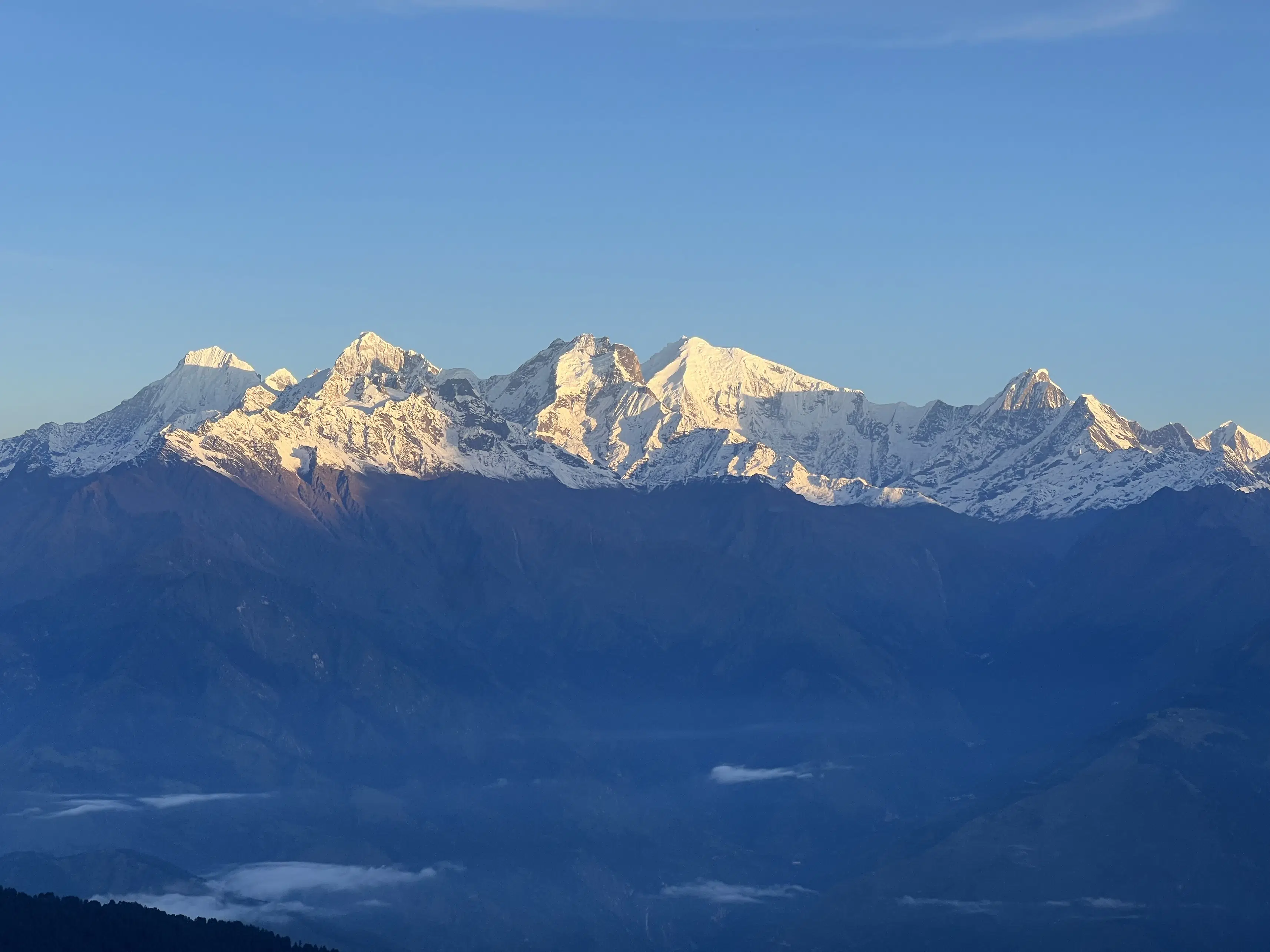
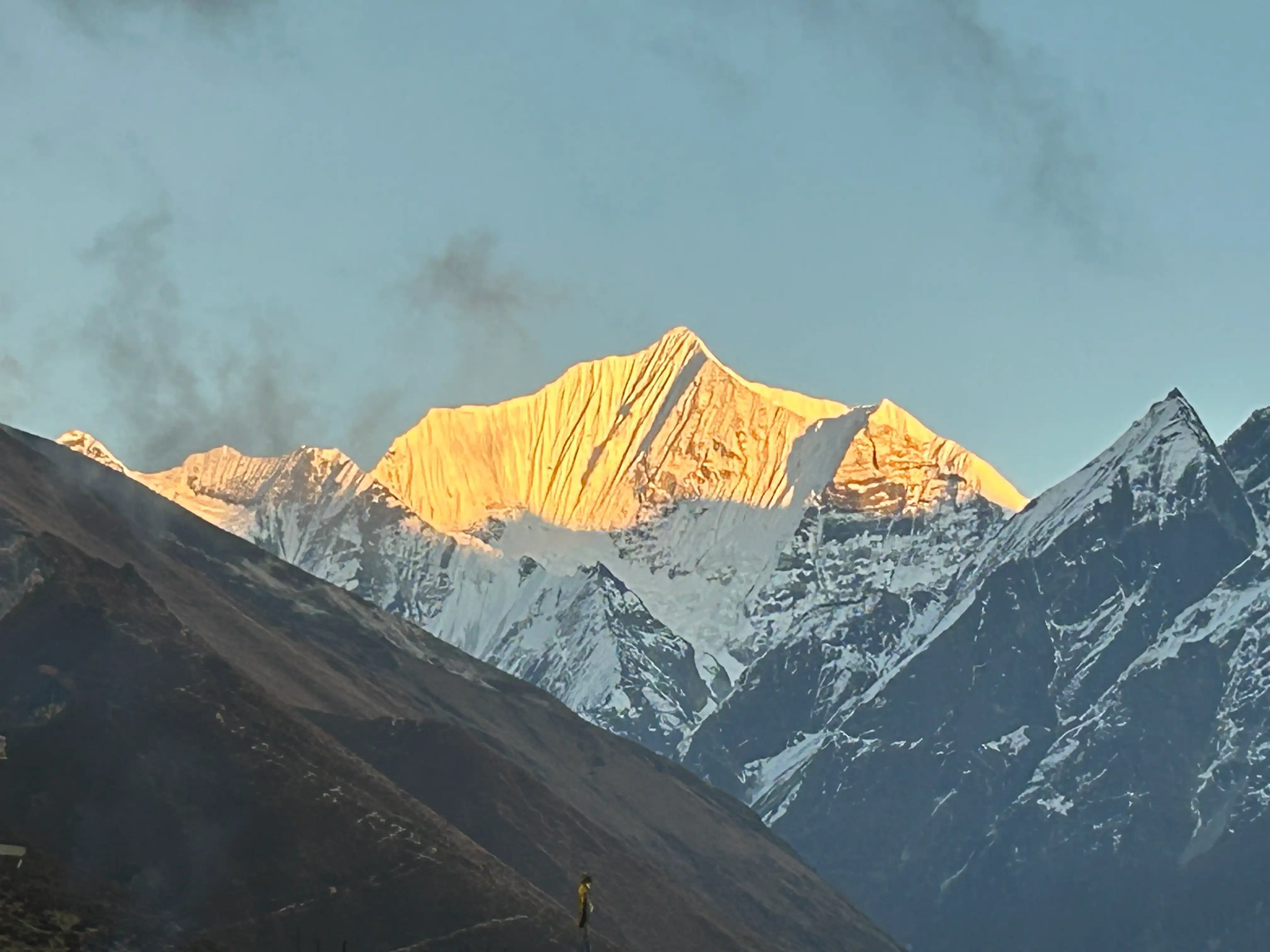
  • You will have the pleasure of seeing spectacular views of mountains, including Langtang Lirung, Dorje Lakpa, Ganesh Himal and so forth.
  • Also, you can see the holy lakes at Gosaikunda, a pilgrim destination for both Hindus and Buddhists.
  • Cross the famous Laurebina Pass (4,610m), which is one of the best parts of the trek.
  • Experience amazing changes from the glacial valley to the high mountain pass and from the forested ridges to the high mountain pass.
  • Go hiking in the peaceful landscapes of the Helambu and Chisapani region.
  • Get amazed by the sunrise and sunset views at various points in the trekking route.
  • Experience varied ecosystems, including subtropical forests, alpine vegetation, and other types of plants and animals.

Overview

Langtang Gosaikunda Chisapani Trek is an exciting 16-day trek that includes the scenic beauty of Langtang Valley, the sacred lakes of Gosaikunda, and the forest trails of the Helambu region. It passes through Tamang villages, dense rhododendron and bamboo forests, and glacial valley regions. You get to experience the cultural beauty, scenic beauty, and the Himalayas views through this trek. Once inside the Langtang Valley, you will find the scenic beauty of the Himalayas, which will lead you to the beautiful settlement of Kyanjin Gompa. From here, you can enjoy a hike either to Kyanjin Ri or Tserko Ri to enjoy the panoramic view of Langtang Lirung, glaciers, and peaks. The trek goes towards the sacred Gosaikunda, where you will find alpine lakes in the rugged high altitude region considered to be blessed by Lord Shiva. You cross the Laurebina Pass (4,610m) and enjoy Himalayan views. The final part of your journey involves a descent from the hills and forest regions of Helambu through Chisapani to Sundarijal near Kathmandu.

Itinerary

Day 1: Arrival in Kathmandu and Transfer to Hotel

Upon reaching the international airport of Kathmandu, you will be greeted by our representative, who will help you to travel to your hotel in a private vehicle. You will have your first taste of the hectic roads, the cultural diversity and the bustling life of the city through this drive. After settling down in your room and taking a rest from the trip, you have your afternoon at leisure for your convenience. The rest of the day will be at leisure, depending upon your arrival time.

  • Max Elevation: 1,400m (Kathmandu)
  • Travel Distance: ~5–10 km (airport to hotel)
  • Travel Hours: 20–40 mins
  • Accommodation: Hotel in Kathmandu
  • Meal: Welcome dinner 
Day 2: Kathmandu Sightseeing and Trek Briefing

On this day, you will visit some of the UNESCO World Heritage Sites in the Kathmandu Valley. After a delicious breakfast, an experienced guide will provide you with information about the trekking route, necessary gear, safety guidelines and altitude awareness. You will then embark on a sightseeing trip in a private vehicle, exploring some of Nepal's major cultural and religious sites.

Boudhanath Stupa: Boudhanath Stupa is located in the northeastern part of Kathmandu and is one of the largest stupas on earth. It also serves as a center for Tibetan Buddhism. The white dome and colorful prayer flags create a serene atmosphere. There is always the presence of the sound of pilgrims and monks chanting mantras while spinning the prayer wheels in the vicinity of the stupa.

Pashupatinath Temple: The Pashupatinath Temple is the holiest temple for Hindu worshippers in Nepal, which is built in the vicinity of the Bagmati River in Nepal. The temple is famous for its pagoda style and its spiritual practices.

Patan Durbar Square: Patan Durbar Square is found in Lalitpur and is a place where some of the best examples of the Newari architecture can be seen. The square used to be the palace of the Malla Kings and boasts several carved temples and shrines, which reflect the artistic excellence in Kathmandu Valley.

Swayambhunath Stupa: Situated atop a hill overlooking the city of Kathmandu is Swayambhunath, one of the oldest and most sacred religious sites of Nepal. It is also known as Monkey Temple. The temple offers panoramic valley views, a stupa, a prayer wheel, shrines and many monkeys.

You will return to your hotel after exploring these incredible heritage sites and prepare for the trek the next day.

  • Max Elevation: 1,400m
  • Travel Distance: ~20–25 km (city tour)
  • Travel Hours: 5–6 hrs sightseeing
  • Accommodation: Hotel in Kathmandu
  • Meal: Breakfast
Day 3: Drive to Syabrubesi (1,467m)

Following breakfast, you begin on your journey out of Kathmandu en route to Syabrubesi, which opens up the region of Langtang.The drive follows winding mountain roads through the Pasang Lhamu Highway to experience terrace farming, riverside towns, forested hills, and the scenic countryside. You move from the busy streets of Kathmandu Valley to the mountainous region and the rustic village environment. During your journey, you can get some glimpses of the majestic peaks of the Ganesh Himal, Manaslu, and other Himalayan peaks. Your drive takes you through the typical life of the Nepali people residing in the mid-hill areas as you come across roadside bazaars along the way.

Syabrubesi is a small town located alongside the Bhote Koshi River and forms the starting point for most treks to the Langtang region. The place is inhabited by the Tamangs, whose culture, language, architectural style, and tradition are heavily influenced by Tibetan culture. 

  • Max Elevation: 1,467m
  • Travel Distance: ~120–140 km
  • Travel Hours: 6–8 hrs
  • Accommodation: Teahouse in Syabrubesi
  • Meal: Breakfast, Lunch, Dinner
Day 4: Trek to Lama Hotel (2,470m)

Your adventure begins today as you move out of Syabrubesi to the lower reaches of the Langtang Valley. The trail involves crossing suspension bridges and then follows Langtang Khola through an ascent into dense oak, bamboo, rhododendron, pine forests, and also get the opportunity to see wild honey (Bey Hive), wild monkey (langur), and musk deer. This part of the trek will take you through humid river valleys and subtropical forests to reach the temperate zone in gradual stages. The forest walk will provide you with an exciting time with the sound of flowing streams and singing birds.

As you move, you near your destination which lies within the boundaries of the Langtang National Park, a conservation site located in the Himalayas of Nepal. The walk will involve some ascents, stone stairs, and forest walks, which will help you get accustomed to the high altitudes of the region. Finally, after walking through the valley for a few hours, you will reach your first destination, which is Lama Hotel.

  • Max Elevation: 2,470m
  • Travel Distance: ~11–12 km
  • Travel Hours: 6 hrs
  • Accommodation: Teahouse in Lama Hotel
  • Meal: Breakfast, Lunch, Dinner
Day 5: Trek to Langtang Village (3,430m)

Today’s hike will continue ascending as we enter the forest, which slowly starts to disappear, and the valley opens up towards higher elevations and wider alpine landscapes. With increasing altitude, the environment becomes more impressive and the majestic mountain of Langtang Lirung (7,227m) gradually appears on our horizon.

You then pass through Ghodatabela, a picturesque place which has long served as an important stop along the Langtang trekking route and which is famous for its spacious landscape and mountains. As you continue your journey, you will see traditional stone houses, prayer flags, mani walls and many other Buddhist elements, showing you how influential the culture of Tibetan Buddhism is in this valley. The landscape changes, and you start to see the transition from forests to alpine landscapes, where there are possibilities to see grazing grounds for yaks and beautiful mountain views. Wildlife found in the park includes red pandas, Himalayan black bears, langur monkeys, Himalayan tahr, and various bird species, though sightings are rare. Additionally, you may even encounter wild hornets, which are highly territorial species of insects. So if you do see one, you should be wary of them. 

Arriving in Langtang Village, we find ourselves in one of the biggest settlements of the valley, inhabited mostly by people of Tibetan origin. This village was very much influenced by the earthquake and avalanche in 2015; however, it managed to rebuild itself and stand firm with the help of the local population. Nowadays, Langtang Village is strong evidence of revival while maintaining its mountain culture and way of life.

  • Max Elevation: 3,430m
  • Travel Distance: ~14–15 km
  • Travel Hours: 6 hrs
  • Accommodation: Teahouse in Langtang Village
  • Meal: Breakfast, Lunch, Dinner
Day 6: Trek to Kyanjin Gompa (3,870m) and Explore

While today’s trek is relatively shorter in distance, it promises lots of rewards as you delve further into the upper Langtang Valley. It involves climbing through pasturelands where yak graze, settlements made of stones, prayer wheels, and mani walls that have Buddhist carvings. As the trek progresses, there are more dramatic landscapes where high peaks, glaciers, and valleys dominate the landscape. There are also wide open spaces and vistas with magnificent alpine scenery, making this among the most scenic portions of the trekking adventure.

Eventually, you will arrive at Kyanjin Gompa, the heart of culture and spirituality within the region of Langtang. This settlement is known for its ancient Buddhist monastery and also a cheese factory where a traditional cheese factory was established with Swiss support, producing local Himalayan cheese. There will be ample opportunity to rest and acclimatize in the afternoon due to the short distance. You can either explore the surroundings, visit the monastery, watch cheese being made, or even relax in the mountains.

Here you can view some of the most notable mountain views in this part, including Langtang Lirung, Yala Peak, Langshisa Ri, and other glaciated mountains.

  • Max Elevation: 3,870m
  • Travel Distance: ~6–7 km
  • Travel Hours: 3–4 hrs
  • Accommodation: Teahouse in Kyanjin Gompa
  • Meal: Breakfast, Lunch, Dinner
Day 7: Acclimatization Hike to Kyanjin Ri (4,773m) or Tserko Ri (5,000m)

Today’s journey will be all about acclimatizing and exploring for a more pleasant hiking adventure. This is based on the trekking concept where you need to “climb high, sleep low” and allow your body to acclimatize slowly to the altitude as you come back to sleep at lower altitudes. There are two well-known viewpoints available based on the choice that you make.

Kyanjin Ri (4,773 meters): This is the easier viewpoint that has stunning views from the valley and surrounding glaciers, moraines, and other neighboring mountains.

Tserko Ri (5,000 meters): This is a longer viewpoint that gives you one of the best views in the area.

From the summit area, broad views stretch across the Langtang Himal range and toward the Tibetan frontier. Throughout the day, you are surrounded by dramatic mountain scenery and wide open Himalayan landscapes that make this one of the highlights of the trek. After enjoying the views and spending time at elevation, you descend back to Kyanjin Gompa for rest and an overnight stay.

  • Max Elevation: 5,000m
  • Travel Distance: ~6–10 km (round trip hike)
  • Travel Hours: 4–8 hrs
  • Accommodation: Teahouse in Kyanjin Gompa
  • Meal: Breakfast, Lunch, Dinner
Day 8: Trek Down to Lama Hotel (2,470m)

After having spent some time in the high altitude environment of Kyanjin Gompa, you will be heading back down the valley today. Taking the same path again, there is definitely a whole new way to look at the landscape as you make your way back down, with different lighting and larger viewscapes that bring out aspects you didn’t notice when coming up.

The descent takes you back through the Langtang Village and Ghodatabela, making your way along the Langtang Khola through large valleys until you begin entering the rhododendron, oak, bamboo, and pine forests. Breathing will get easier along the way because of the decreased altitude. It will be nice to come back to the forest from the glacial area. This is one of those good days for resting after several days spent at a higher altitude.

There will be many pleasant sounds to listen to, from the flowing river and the surrounding forest, until you reach the Lama Hotel again.

  • Max Elevation: 3,870m (start point)
  • Travel Distance: ~18–20 km
  • Travel Hours: 6–7 hrs
  • Accommodation: Teahouse in Lama Hotel
  • Meal: Breakfast, Lunch, Dinner
Day 9: Trek to Thulo Syabru (2,250m)

Today marks the point at which the path diverges from the primary route along the Langtang Valley and begins to move into the second phase of the trek, leading toward the Gosaikunda and Helambu section of the trek. The path consists of a series of ascents and descents through forested hills, settlements, and mountain trails. There are even times when breaks in the trees allow views of the Himalayan peaks that surround the valley.

As the area becomes more civilized, you get the chance to see how people live in the area. At last, you will arrive at Thulo Syabru, an old Tamang settlement situated on the side of a hill above the valley. The village is famous for its stone buildings, terraced farmland, prayer flags, and distinct Buddhist culture. On a good day, you can see the views of the Langtang range and Ganesh Himal from the village. 

  • Max Elevation: 2,470m (pass variation)
  • Travel Distance: ~10–12 km
  • Travel Hours: 5–6 hrs
  • Accommodation: Teahouse in Thulo Syabru
  • Meal: Breakfast, Lunch, Dinner
Day 10: Trek to Sing Gompa / Chandanbari (3,330m)

After leaving Thulo Syabru behind, the path will rise gradually through rhododendron, pine, and oak forests as you move higher and higher towards the holy Gosaikunda area. This portion of the trek is tranquil, shaded, and frequently marked by bird songs and a quiet mountain setting. In spring, blooming rhododendrons make the area even more beautiful and thus make this portion of the trek very picturesque.

As elevation rises, the forest starts thinning, and views start opening up towards the surrounding mountains. Ultimately, you will reach Sing Gompa (alternatively named Chandanbari), which is a little hamlet famous for being spiritually significant and having rich traditions. In the region, there is a Buddhist monastery as well as a traditional yak cheese factory that has earned a reputation among trekkers. Trekkers can even watch the production of yak cheese and enjoy the local products.

From Sing Gompa, clear skies offer magnificent views of Langtang Lirung and Ganesh Himal mountains and their neighbors.

  • Max Elevation: 3,330m
  • Travel Distance: ~8–10 km
  • Travel Hours: 5–6 hrs
  • Accommodation: Teahouse in Sing Gompa
  • Meal: Breakfast, Lunch, Dinner
Day 11: Trek to Gosaikunda Lake (4,380m)

Today's trek will take you to the higher reaches where the treeline ends, and you find yourself in rough alpine terrain as you move towards one of Nepal’s holiest alpine lake regions. The track will gradually leave the forest zone behind and will take you to an open zone where the path is rocky and alpine vegetation can be seen, along with views of majestic mountains.

With the increase in altitude, the environment around will become quite tranquil and remote. Prior to the main lake, your path will pass through Laurebina, which is a very famous halt place and offers vast views of the Himalayan Range.

Gosaikunda comprises several alpine lakes which lie interrelated to each other on the high mountain range. As per Hindu mythology, Lord Shiva created the Gosaikunda by hitting the mountain with his trident to procure water. Today, Gosaikunda stands as one of the significant pilgrimage places for Hindus and Buddhists alike, especially during the festival of Janai Purnima.

Encircled by bare mountains, Gosaikunda Lake, with its clear and pristine water, offers a unique mountain environment in Nepal.

  • Max Elevation: 4,380m
  • Travel Distance: ~10–12 km
  • Travel Hours: 5–6 hrs
  • Accommodation: Teahouse in Gosaikunda
  • Meal: Breakfast, Lunch, Dinner
Day 12: Cross Laurebina La Pass (4,610m) and Trek to Ghopte (3,430m)

It is the most difficult day of the whole trekking period, but also one of the most exciting ones, which will require getting up in the morning since there is usually calm weather at that time. After leaving Gosaikunda, the trekking trail continues past several holy alpine lakes and ascends to the Laurebina Pass (4,610m), which is the highest altitude of the trip.

From there, you can enjoy stunning panoramic views of the area, including the Langtang Himal, Ganesh Himal, Dorje Lakpa, Jugal Himal, and even the Tibetan mountains when the weather is clear. It is a wild landscape created by strong winds, alpine slopes, and beautiful mountains around.

Having passed the pass, you start a long descent along rough trails, which soon turn into peaceful ridge areas as you enter the Helambu area. It is the most amazing experience to get from the rocky alpine terrain to greener parts of the landscape. By the end of the day, you reach Ghopte, which is a very remote settlement surrounded by forests and mountain wilderness.

  • Max Elevation: 4,610m
  • Travel Distance: ~12–14 km
  • Travel Hours: 6–7 hrs
  • Accommodation: Teahouse in Ghopte
  • Meal: Breakfast, Lunch, Dinner
Day 13: Trek to Kutumsang (2,470m)

Having crossed the alpine terrain of Laurebina Pass yesterday, the current route takes on a much calmer and relaxed feel, continuing downhill in the scenic beauty of the Helambu region. Following the ridgeline trails, the walk takes you through patches of rhododendrons, oaks, pines, and other woodland, combined with views from open patches and some rural settlements. Unlike the previous two days of walking, this day will provide a slightly easier time with more leisurely scenery of Nepal's mid-hills.

This area has traditionally been used as one of the links between local mountain travel and trade routes within the hills. On your journey here, you can see some of the ancient agricultural practices, terraced farming and typical village life.

After some time, you will find yourself at the traditional hill settlement of Kutumsang, which is inhabited by local mountain communities. This village is characterized by stonewalled traditional houses, terraces of farmland, and the simple mountain life that characterizes such areas in Nepal. If the weather permits from the surrounding ridges, you can get some distant views of the Langtang mountains, as well as the rolling green valleys that lead into central Nepal.

  • Max Elevation: 2,470m
  • Travel Distance: ~14–16 km
  • Travel Hours: 5–6 hrs
  • Accommodation: Teahouse in Kutumsang
  • Meal: Breakfast, Lunch, Dinner
Day 14: Trek to Chisapani (2,165m)

Trekking today goes on amidst picturesque mid-hill settings as the trail steadily descends into forested ridges en route to the Kathmandu Valley fringes. The trek route takes you through oak, pine, and rhododendron forests that constitute the wider ecosystem associated with the forested area connected to Shivapuri Nagarjun National Park. Your trekking is relaxing and features occasional glimpses through gaps of hills, valleys, and the distant Himalayan ranges.

Approaching Chisapani, the ambiance slowly changes from the remoteness of mountain landscapes to those of settlements affected by their location near Kathmandu. At last, you reach Chisapani, which is a famous hill settlement famed for its panoramic Himalayan views and the great sunrise and sunset vantage points. On clear days, the view of mountains might extend to several Himalayan ranges, like some parts of the Langtang region and even farther to the east and west of the valley.

The easygoing atmosphere and moderate elevation of Chisapani make it a comfortable place to spend the last night in before trekking back to Kathmandu.

  • Max Elevation: 2,165m
  • Travel Distance: ~12–14 km
  • Travel Hours: 4–5 hrs
  • Accommodation: Teahouse in Chisapani
  • Meal: Breakfast, Lunch, Dinner
Day 15: Trek to Sundarijal and Drive to Kathmandu

Today is the last day of your trek as you hike down through dense forest until you find yourself back at the valley of Kathmandu. The trail includes stone stairs, wooden paths of shady forests, and small streams in the protected region of Shivapuri Nagarjun National Park. The area today is quite different from that you trekked through earlier on; today's environment is much greener and softer.

There are many birds and plants in the forest that will give you a chance to enjoy nature one last time before going back to the city. At some point, you reach Sundarijal, a popular gateway to Shivapuri Nagarjun National Park and an important water supply area for Kathmandu. It is known for its waterfalls and as a part of the water supply system of Kathmandu.

From Sundarijal, you drive back to Kathmandu. In the afternoon, you have free time after settling into the hotel. You can relax, explore the city, go shopping, or celebrate successfully completing the trip. Your trip has included a wide range of terrains from rivers and forests to lakes, high alps, and mountain villages. 

  • Max Elevation: 2,165m (start point)
  • Travel Distance: ~15–17 km trek + 15 km drive
  • Travel Hours: 3–4 hrs trek + 1 hr drive
  • Accommodation: Hotel in Kathmandu
  • Meal: Breakfast, Lunch, Dinner
Day 16: Final Departure

Following your breakfast, you start preparing for the departure from Nepal. Your travel representative will arrange your transfer to Tribhuvan International Airport, depending on your scheduled flight timing. They will help you with all the necessary arrangements during your departure from Nepal. As you depart Nepal, you depart carrying along memories of the striking scenery at Langtang Valley, spiritual experiences at Gosaikunda Lake, your success in crossing Laurebina Pass, and the experience of meeting the friendly mountain people along the way. From the dense forests and glacier valleys, to the isolated monasteries and Himalayan views, your trip here is indeed one of a lifetime experience in Nepal. We hope to welcome you again for another Himalayan adventure in the future. 

  • Max Elevation: 1,400m
  • Travel Distance: ~5–10 km (to airport)
  • Travel Hours: 20–40 mins
  • Meal: Breakfast

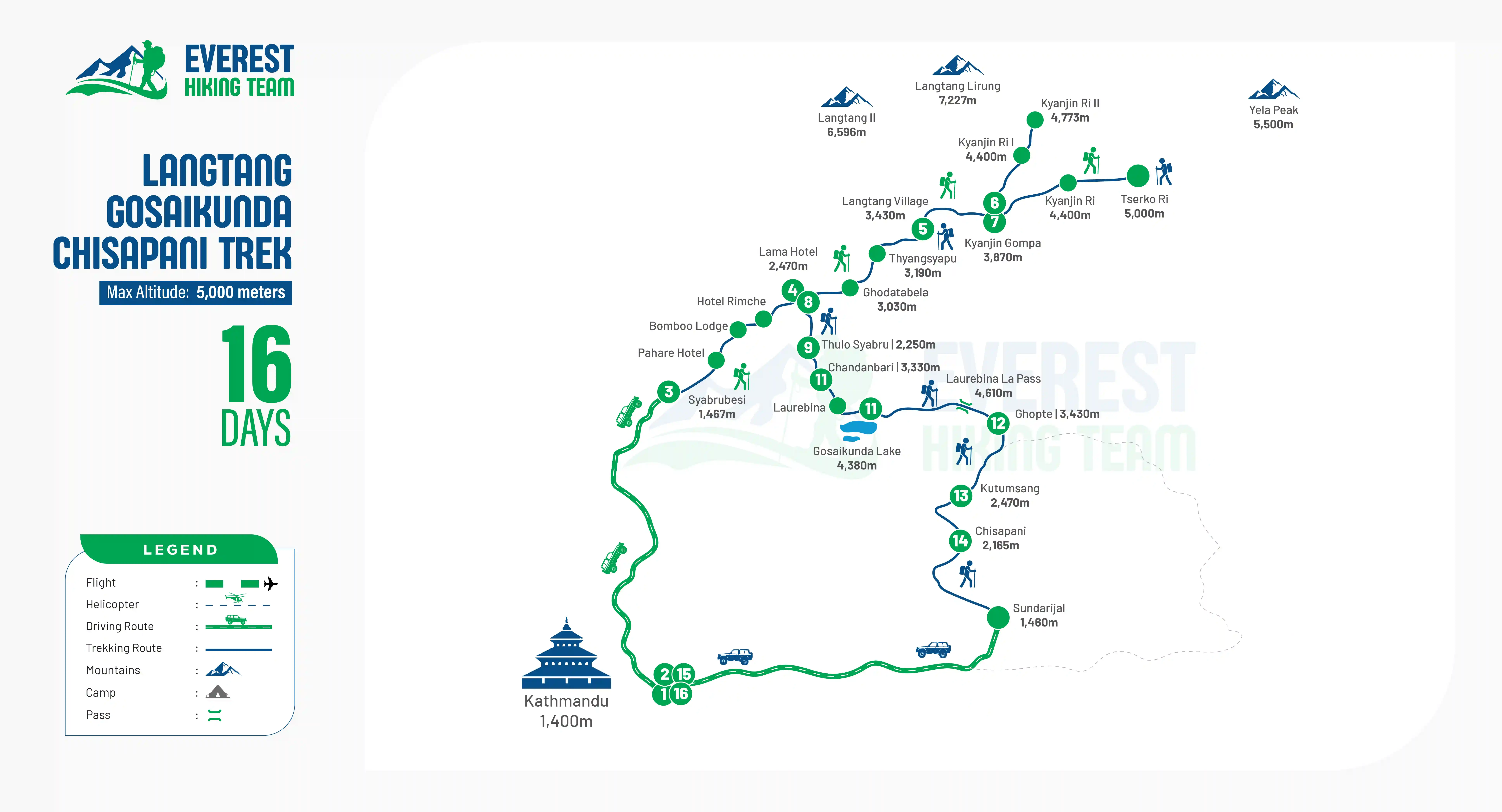
Trek Route

Langtang Gosaikunda Chisapani Trek 16 Days

What's included

  • Airport pick-up and drop service in a private vehicle
  • All ground transportation as per the itinerary (Kathmandu–Syabrubesi and Sundarijal–Kathmandu)
  • Kathmandu city tour in private vahicles with an experinced tour guide.
  • 3-night hotel accommodation in Kathmandu  (before 2 Nights and after trek 1 Nights ) with breakfast
  • Teahouse/lodge accommodation during the trek
  • Three meals (breakfast, lunch, and dinner with the 3 cop of tea/coffee per day ) during the trekking period
  • Experienced, licensed English-speaking trekking guide
  • 1 porter for every 2 trekkers), including their food, accommodation, and insurance
  • Langtang National Park entry permit and TIMS card
  • All government taxes and official service charges
  • First aid medical kit carried by the guide
  • Trekking briefing and assistance before departure
  • trekking map 

What's excluded

  • International airfare to and from Nepal
  • Nepal entry visa fees
  • Lunch and dinner in Kathmandu
  • Personal trekking equipment (boots, down jacket, sleeping bag, etc.)Travel and rescue insurance (mandatory, must cover high-altitude evacuation)
  • Hot showers, Wi-Fi, and charging fees during the trek
  • Personal expenses (drinks, snacks, laundry, phone calls, etc.)Tips for guide and porter (expected but not mandatory)
  • Extra nights in Kathmandu due to early arrival, late departure, or unforeseen delays
  • Any costs arising from natural calamities, flight delays, or itinerary changes beyond control
  • trekking map.

Packaging List

Clothing

  • Moisture-wicking base layers (2-3 sets)
  • Warm fleece or down Jacket (essential for High Altitude)
  • Windproof and waterproof jacket
  • Waterproof hiking pants or quick-drying trousers (2-4 pairs)
  • Thermal innerwear (tops and bottoms)
  • Lightweight t-shirts
  • Warm hat/beanie to wear on cold mornings and evenings
  • Sun Hat or Cap for Daytime
  • Neck gaiter (for protection from wind and dust)
  • Gloves (lightweight pair with insulated gloves for higher altitudes)
  • Comfy underwear and hiking socks (wool is recommended).Footwear
  • Trekking boots with ankle support that are well-worn in
  • Lightweight sandals for teahouses
  • Extra trekking socks (4-6 pairs)

Trekking Gear

  • Daypack (25 to 35L for essentials).Duffel bag (usually included with porter service).Sleeping bag (rated between -10 °C and -15 °C)
  • Trekking poles are very useful for long descents or crossing passes. Headlamp with
  • Extra Batteries
  • Hydration bladders or water bottles (2-3L)
  • Filter bottles or tablets for water purification

Personal Care and Hygiene

  • Sunscreen (SPF30+)
  • Lip balm UV protection
  • Toothbrush, toothpaste, biodegradable soap
  • Quick-dry towel
  • Hand sanitizers and wet wipes
  • Toilet paper is essential for remote areas
  • Basic first aid kit: (blister care, painkillers and bandages, as well as altitude medication, if prescribed).


Electronics and Accessory

  • Power Bank (charger is limited in higher altitudes). 
  • Memory cards/storage extra
  • Charger cables and universal adapters
  • Important Documents
  • Copies of passports and visas
  • Trekking permit (copies, if available)
  • Travel insurance must cover high-altitude trekking, evacuation and other activities.
  • Emergency contact details

Optional but Useful

  • Energy snacks (bars and chocolates)
  • Small Journal or Notebook
  • Dry bags for rain protection
  • Locks for small luggage

Frequently Asked Questions

How challenging is the Langtang Gosaikunda Chisapani Trek?

Langtang Gosaikunda Chisapani Trek is of a moderate to moderately challenging level. Typically, on most of your trekking days, you walk for 5 to 7 hours and reach up to the height of 4,610 meters (Laurebina Pass) and 5,000 meters (Tserko Ri optional hike). Good physical conditioning and some trekking experience are preferable, but you can also do this trek without having any experience beforehand.

Which season is ideal for this trekking route?

The best seasons for undertaking this trekking route are spring (March to May) and autumn (September to November). These are the periods when the weather is normally dry, visibility is good, and trail conditions are steady. In the spring, you will be treated to the blooming rhododendrons.

Do I need any previous experience in trekking this route?

No previous experience is necessary, but preferable. The trek includes many days of long walking at an elevation above 4,000 meters and passing through a high pass.

How high is the risk of altitude sickness?

The trek involves elevations above 4,000–5,000 meters, which means the chances of altitude sickness are moderate. However, there is nothing to worry about, as the acclimatization and gradual ascent have been arranged in this trek. Hydration, walking slowly, and adhering to the guidance of your guide will ensure you are safe and sound.

What kind of accommodation do you get on this trek?

For the purpose of accommodation, you will be accommodated in local teahouses or lodges. These teahouses may not be luxurious, but they give you comfortable beds in twin-sharing rooms, toilet facilities, and hot meals. You will stay in modern hotels in Kathmandu.

Is Wi-Fi and mobile connectivity available during the trek?

There is mobile connectivity available in some low-altitude areas like Syabrubesi, Thulo Syabru, and Chisapani, but when you ascend further up the mountains, they become weak or unavailable. Wi-Fi can be accessed through some teahouses, but not always, and it is charged.

User Review