Everest Base Camp Trek-14 Days

Tour Info

Trip code

E-050

Starting Point/ End Point

Kathmandu

Accommodations

Lodge/ Tea House

Max Altitude

5,545m

Duration

14 days

country

Trip grade

Moderate

Best Season

Spring (March–May) and Autumn (September–November)

Highlights

  • Scenic flight from Kathmandu or Ramechhap to Lukla with views of the hills and Himalayas.
  • Trek through the beautiful Khumbu region and traditional Sherpa villages.
  • Explore Namche Bazaar, the main town and trading center of the Everest region.
  • Enjoy acclimatization days in Namche Bazaar and Dingboche.
  • Visit the famous Tengboche Monastery surrounded by stunning mountain views.
  • Experience Sherpa culture, local traditions, monasteries, and mountain communities.
  • Reach Everest Base Camp at 5,364 meters and see the Khumbu Glacier.
  • Hike to Kala Patthar at 5,545 meters for sunrise views of Mount Everest and nearby peaks.
  • Enjoy views of Everest, Ama Dablam, Lhotse, Nuptse, Pumori, and other Himalayan mountains.
  • Stay in local tea houses and experience the simple lifestyle of the Everest region.
  • Trek through Sagarmatha National Park with rivers, suspension bridges, and mountain landscapes.
  • Complete the classic Everest Base Camp trekking route in 14 days.

Overview

The Everest Base Camp Trek 14 Days is one of Nepal’s most iconic trekking journeys, offering a mix of Himalayan scenery, biodiversity, spiritual culture, and high-altitude adventure. The classic trek takes you into the Khumbu region, home to majestic mountains, Sherpa villages, ancient monasteries, and mountain communities. Trail passes through rhododendron forests, farmland, high-altitude paths, and glacial valleys. A major highlight is the sunrise from Kala Patthar (5,545 meters), with views of Mount Everest (8,848 meters), Lhotse (8,516 meters), Makalu (8,481 meters), and other peaks. You will also visit Namche Bazaar, Tengboche, and Dingboche while experiencing Sherpa hospitality and learning about the region’s connection with legendary climber Tenzing Norgay Sherpa. Trek passes through Sagarmatha National Park, a UNESCO World Heritage Site, home to snow leopards, red pandas, and Himalayan Monals. Spring also brings blooming rhododendrons. The journey starts with a 40-minute flight to Lukla and continues to Everest Base Camp (5,364 meters). Along the route, you can experience Buddhist culture, Tengboche Monastery, prayer wheels, mani stones, and prayer flags. The itinerary focuses on safety, acclimatization, and comfort, with options.

Itinerary

Day 1: Arrival in Kathmandu

Your Everest Base Camp adventure begins with your arrival at Tribhuvan International Airport in Kathmandu. Our representative will welcome you at the airport and transfer you to your hotel by private vehicle. You will stay in Thamel, a lively area known for local shops, restaurants, markets, and trekking stores. In the evening, you will have a pre-trek meeting with your trekking guide. The guide will explain the trek, discuss the route and safety guidelines, and check your trekking equipment. You can also ask any questions and make final preparations before starting your journey to Everest Base Camp.

  • Max Elevation: 1400 meters (Kathmandu)
  • Travel Distance: 6 to 8 kilometers
  • Travel Hours: 20 to 30 minutes
  • Accommodation: 3 Star Hotel
  • Meal: Dinner
Day 2: Fly to Lukla from Kathmandu or Ramechhap and Trek to Phakding

The journey into the Everest region begins with a flight to Lukla, the main gateway to the Khumbu region. Depending on the flight schedule, weather, and seasonal operating conditions, the flight may depart from Kathmandu or Ramechhap. If flying from Ramechhap, you will leave Kathmandu early and drive for around four hours to reach the airport before taking the scenic flight to Lukla. After landing at Lukla, you will meet the local porters and begin your trek toward Phakding. The trail follows the Dudh Koshi River and passes through small Sherpa settlements, green hills, prayer flags, mani walls, and chortens. This short and relatively easy walk gives you a gentle start to the trek while allowing you to enjoy the local culture and Himalayan surroundings. You will spend the night at a tea house in Phakding.

  • Max Elevation: 2,610 meters (Phakding)
  • Travel Distance: 7 to 8 kilometers
  • Travel Hours: 3 to 4 hours
  • Accommodation: Tea house /Lodge
  • Meal: Breakfast, Lunch and Dinner
Day 3: Trek to Namche Bazaar from Phakding

After breakfast, you will begin your trek from Phakding toward Namche Bazaar, the main trading and cultural center of the Khumbu region. The trail follows the Dudh Koshi River and passes through small mountain villages, farmland, and forested sections. You will cross several suspension bridges, including the beautiful and high Hillary Bridge, adding to the unique atmosphere of the trail. As you continue, you will reach the entrance of Sagarmatha National Park, a UNESCO World Heritage Site. The route then passes through pine and rhododendron forests, where you may spot Himalayan wildlife and enjoy views of surrounding mountains. Along the way, you can see peaks such as Thamserku and Kongde. After crossing the final suspension bridge, the trail becomes steeper as you begin the climb toward Namche Bazaar. Namche is an important stop for trekkers and climbers heading toward Everest. The town has bakeries, cafes, restaurants, trekking shops, and small markets. If your trek falls on Saturday, you can also get to explore the Saturday market. It is also a useful place to purchase any last-minute essentials, snacks, or personal items before heading toward the higher parts of the Khumbu region. You will spend the night at a local tea house in Namche Bazaar. 

  • Max Elevation: 3,440 meters (Namche Bazaar)
  • Travel Distance: 10 to 12 kilometers
  • Travel Hours: 
  • Accommodation: Tea house /Lodge
  • Meal: Breakfast, Lunch and Dinner
Day 4: Acclimatization day in Namche Bazaar

Today is an acclimatization day in Namche Bazaar, giving your body time to adjust to the increasing altitude before you continue toward the higher parts of the Everest region. Although it is a rest day, a short hike is recommended to keep your body active and help with altitude adjustment. After breakfast, you can take a gradual hike toward the Everest View Hotel area. From the viewpoint, you can enjoy clear views of Mount Everest, Ama Dablam, Lhotse, Nuptse, Tabuche, and other surrounding peaks. The hike also gives you a chance to experience the changing landscape around Namche. Another popular option is to visit Khumjung Village, a traditional Sherpa settlement located in a beautiful mountain valley. The village is known for the Khumjung Hillary School, which was established through the work of Sir Edmund Hillary to support education in the local Sherpa community. You can also explore the village, visit the local monastery, and observe the traditional lifestyle of the people. After the hike, you will return to Namche Bazaar and have the rest of the day to relax, explore the town, or prepare for the next stage of the trek. Your overnight stay will be at a tea house in Namche with warmly served meals.

  • Max Elevation: 3,880 meters (Everest View Hotel)
  • Travel Distance: 4 to 5 kilometers
  • Travel Hours: 3 to 4 hours
  • Accommodation: Tea house /Lodge
  • Meal: Breakfast, Lunch and Dinner
Day 5: Trek to Tengboche from Namche Bazaar

After breakfast, you will leave Namche Bazaar and continue toward Tengboche. This section of the trail has a mix of gentle climbs and descents, making it a pleasant part of the trek. The route follows a scenic hillside with open views of the mountains, giving you plenty of opportunities to stop, rest, and take photos. As you continue along the trail, you will pass colorful prayer flags, Buddhist stupas, and mani walls carved with sacred mantras. The impressive Ama Dablam remains one of the main features of the landscape, while views of Mount Everest, Lhotse, Tabuche, and other peaks can also be seen along the route. Trail eventually descends toward the Dudh Koshi River before climbing through pine and rhododendron forests toward Tengboche. The final section follows a series of switchbacks and gradually brings you to Tengboche, one of the most important cultural and spiritual places in the Khumbu region. Tengboche is home to the famous Tengboche Monastery, which sits on a hilltop with beautiful views of Mount Everest, Lhotse, Ama Dablam and the surrounding mountains. If your arrival matches the prayer schedule, you may have the opportunity to quietly observe a Buddhist ceremony puja at Tyanboche Monastery. After 3 PM, you can also visit the monastery. You can also explore the monastery grounds and learn more about the local Buddhist traditions. After visiting the monastery, you will settle into a nearby tea house and enjoy the peaceful mountain surroundings.

  • Max Elevation: 3,860 meters (Tengboche)
  • Travel Distance: 9 to 10 kilometers
  • Travel Hours: 5 to 6 hours
  • Accommodation: Tea house /Lodge
  • Meal: Breakfast, Lunch and Dinner
Day 6: Trek to Dingboche from Tengboche

You leave Tengboche today after breakfast and begin the trek toward Dingboche. The trail first descends through beautiful rhododendron and fir forests toward Debuche. You will then cross a suspension bridge over the Imja Khola, after crossing the bridge, you can enjoy one of the beautiful and closer views of Ama Dablam, and continue toward Pangboche, one of the oldest and most well-known villages in the Khumbu region. From Pangboche, the trail gradually climbs through the Imja Valley. You will pass small settlements such as Shomare, Orsho, and Tsuro Wog, with views of the surrounding mountains becoming more impressive as you gain altitude. Along the route, you can see peaks including Ama Dablam, Thamserku, Taboche, Cholatse, and Lhotse. As you move higher, the dense forests gradually disappear and the landscape becomes wider and more open. You will walk past grazing yaks, Buddhist chortens, prayer walls, and stone-built fields. The trail eventually reaches Dingboche, a popular high-altitude settlement surrounded by impressive Himalayan peaks. Dingboche is known for its stone-walled fields, which help protect crops from the strong mountain winds and cold weather. As the air becomes thinner at this altitude, the pace becomes slower and steady. After reaching the village, you can relax at the teahouse or lodge, enjoy a warm meal, and take in the views of the surrounding mountains. 

  • Max Elevation: 4,410 meters (Dingboche)
  • Travel Distance: 10 to 11 kilometers
  • Travel Hours: 5 to 6 hours
  • Accommodation: Tea house /Lodge
  • Meal: Breakfast, Lunch and Dinner
Day 7: Acclimatization day in Dingboche

This is another important acclimatization day in Dingboche. As you move higher into the Everest region, giving your body enough time to adjust to the thinner air becomes increasingly important. Rather than spending the whole day resting, you will take a short hike up the hills at a comfortable pace and return to Dingboche to sleep at the same altitude. One of the popular options for today is the hike to Nangkartshang Viewpoint, a ridge located above Dingboche. The climb takes around 1.5 to 2 hours and offers wide views of the surrounding Himalayan landscape. From the viewpoint, you can see impressive peaks such as Mount Makalu, Lhotse, Ama Dablam, Island Peak, and other mountains in the region. During the hike, you will pass prayer flags, Buddhist symbols, and quiet mountain surroundings. The climb can feel challenging because of the altitude, so you will maintain a slow and steady pace with regular breaks. After returning to Dingboche, you can enjoy a warm meal and spend the afternoon resting or exploring the village in your teahouse or lodge. This acclimatization day helps prepare your body for the higher elevations ahead, including Lobuche, Gorakshep, and Everest Base Camp.

  • Max Elevation: 5,000 meters (Nangkartshang Viewpoint)
  • Travel Distance: 4 to 5 kilometers
  • Travel Hours: 3 to 4 hours
  • Accommodation: Tea house /Lodge
  • Meal: Breakfast, Lunch and Dinner
Day 8: Trek to Lobuche from Dingboche

As you continue your trek towards Lobuche, you leave Dingboche after having breakfast, taking you deeper into the high-altitude landscape of the Khumbu region. The trail begins with a gradual climb above the Pheriche Valley, with wide views of the valley and surrounding mountains. From this location, we can see beautiful close views of Cholatse, Tabuche, Lobuche, in front of us alongside close and beautiful views of Ama Dablam behind us. As you gain altitude, the vegetation becomes thinner and the landscape changes into open alpine terrain. The trail passes through yak pastures and rocky sections, with views of Taboche and Cholatse along the way. Ama Dablam remains visible for some time before gradually disappearing behind the surrounding mountains as you move farther toward Lobuche. Before reaching Thukla Pass, we will arrive at Thukla, where we will have a lunch break. After lunch, we will continue with an uphill walk of around one hour to reach Thukla Pass, where the Everest Memorial is located at the top of the climb. One of the more demanding sections of the day is the climb toward Thukla Pass, also known as Dughla Pass. The ascent is steep, and the increasing altitude can make the climb feel more difficult. You will maintain a slow and steady pace with breaks as needed. After the uphill walk, you will reach the top of Thukla Pass, where you will find the memorials and stone cairns dedicated to climbers and mountaineers who lost their lives in the Everest region. From Thukla Pass, the trail becomes more gradual as it continues toward Lobuche. The surrounding landscape becomes rocky and dramatic, with views of Nuptse, and other high Himalayan peaks. After several hours of trekking, you will reach Lobuche, where you can rest, enjoy a warm meal, and prepare for the upcoming trek to Everest Base Camp. Overnight stay will be at a tea house in Lobuche. 

  • Max Elevation: 4,940 meters (Lobuche)
  • Travel Distance: 11 kilometers
  • Travel Hours: 5 to 6 hours
  • Accommodation: Tea house /Lodge
  • Meal: Breakfast, Lunch and Dinner
Day 9: Trek to Gorakshep from Lobuche and Visit Everest Base Camp

This is one of the most exciting days of the Everest Base Camp Trek as you finally reach the famous Everest Base Camp. After breakfast, you will leave Lobuche early in the morning  and begin the trek toward Gorakshep. After around three hours of trekking, you will reach Gorakshep at approximately 5,180 meters. This is the last settlement before Everest Base Camp and is surrounded by a barren, high-altitude landscape. You will have lunch and take a short rest before continuing toward the main destination of the day. In the afternoon, you will begin the trek from Gorakshep to Everest Base Camp, which takes around two hours. As you get closer to Base Camp, the views become more impressive, with the Khumbu Icefall and  surrounding peaks creating a dramatic Himalayan setting. After reaching Everest Base Camp at 5,364 meters, you will have time to explore the area, take photographs, and enjoy the achievement. You can see impressive peaks such as Everest, Lho La, Nuptse, Pumori, and Khumbutse. That said, you do have to note that you can see the summit on the way, so you should keep an eye out for that. After spending some time at Base Camp, you will return to Gorakshep for the night. The return journey is a bit easier and takes less than two hours. The next morning, you will hike to Kala Patthar for sunrise and some of the best panoramic views of Mount Everest. Overnight stay will be at a tea house in Gorakshep.

  • Max Elevation: 5,364 meters (Everest Base Camp)
  • Travel Distance: 12 to 13 kilometers
  • Travel Hours: 7 to 8 hours
  • Accommodation: Tea house /Lodge
  • Meal: Breakfast, Lunch and Dinner
Day 10: Kala Patthar Sunrise View and Then Trek to Pheriche

You start the morning early with a hike to Kala Patthar, one of the best viewpoints in the Everest region. At 5,545 meters, it is the highest point of this trek and offers wide views of Mount Everest, Nuptse, Lhotse, Pumori, and other Himalayan peaks. The hike to the top takes around 2 hours, and the sunrise from Kala Patthar is especially impressive as the first light reaches the surrounding mountains. After spending some time at the viewpoint and taking photographs, you will descend back to Gorakshep, which takes less than 2 hours, and have breakfast. If you have already visited Kala Patthar earlier, you can use the morning to rest or enjoy the surrounding area before continuing the descent.

After breakfast, you will begin the trek toward Pheriche. On the way, you will pass through Lobuche, Thukla, and Thukla Pass, where you can see the memorials dedicated to climbers and mountaineers who lost their lives in the Everest region. The trail gradually descends through the rocky high-altitude landscape, making the walk easier as you lose elevation. You will pass through familiar sections of the route before reaching Pheriche, a small mountain village located at around 4,120 meters. Pheriche is also home to the Himalayan Rescue Association clinic, which provides important medical support to trekkers and local communities in the region. After reaching the village, you can rest and spend the night there, enjoy a warm meal, and recover from the high-altitude section of the trek.

  • Max Elevation: 5,545 meters (Kala Patthar)
  • Travel Distance: 10 to 11 kilometers
  • Travel Hours: 7 to 8 hours
  • Accommodation: Tea house /Lodge
  • Meal: Breakfast, Lunch and Dinner
Day 11: Trek to Namche Bazaar from Pheriche

After breakfast, you will leave Pheriche and begin your return journey toward Namche Bazaar. Most of the route is downhill, although there are a few uphill sections along the way. The lower altitude makes breathing easier, so you can enjoy a more comfortable pace while taking in the changing scenery. The trail passes through familiar villages such as Pangboche and Tengboche before continuing toward the Dudh Koshi River. As you descend, the landscape gradually changes from dry and rocky terrain to greener surroundings. Pine and rhododendron forests become more common, providing a refreshing change after several days in the high-altitude environment. You will continue through small Sherpa settlements and cross suspension bridges before making the final climb toward Namche Bazaar. After reaching Namche, you can relax and enjoy some of the facilities that are harder to find at higher elevations. You may take a hot shower, visit a local cafe, or connect with friends and family using the available Wi-Fi. The evening is also a good time to celebrate completing the main Everest Base Camp section of your journey. Enjoy a warm dinner and relax in the lively atmosphere of Namche Bazaar before continuing toward Lukla the following day. Here, you are going to spend the night at a tea house before tomorrow's journey.

  • Max Elevation: 3,440 meters (Namche Bazaar)
  • Travel Distance: 14 to 15 kilometers
  • Travel Hours: 6 to 7 hours
  • Accommodation: Tea house /Lodge
  • Meal: Breakfast, Lunch and Dinner
Day 12: Trek to Lukla from Namche Bazaar

You will begin your final day of trekking from Namche Bazaar to Lukla, after having breakfast. The trail follows the familiar route back through the Khumbu Valley, giving you a chance to enjoy the mountain scenery one more time. As you descend, the trail becomes greener and the air feels warmer and easier to breathe. You will pass through several Sherpa villages and cross suspension bridges while following the Dudh Koshi River. The route also takes you through forested sections of pine and rhododendron, offering a pleasant change from the rocky landscapes of the higher elevations. Along the way, you can look back on the journey and enjoy your final views of the Himalayan peaks and valleys. The trek may feel long after several days on the trail, but the excitement of completing the Everest Base Camp journey keeps you moving toward Lukla. After reaching Lukla, you will check into your tea house and have time to rest. You can also spend the evening with your trekking team, enjoy a warm dinner, and celebrate the completion of your Himalayan adventure before your flight back to Kathmandu.

  • Max Elevation: 2,860 meters (Lukla)
  • Travel Distance: 18 kilometers
  • Travel Hours: 6 to 7 hours
  • Accommodation: Tea house /Lodge
  • Meal: Breakfast, Lunch and Dinner
Day 13: Fly to Kathmandu from Lukla

Your journey continues after having breakfast, and moving towards Lukla Airport for your flight back to Kathmandu. Depending on the flight schedule, weather, and seasonal operating conditions, you may fly directly to Kathmandu or to Ramechhap. The short flight offers one last chance to enjoy views of the hills and Himalayan landscapes you have explored during the trek. If you fly to Ramechhap, you will continue the journey to Kathmandu by road, which takes around four hours. If the flight lands directly in Kathmandu, our representative will pick you up and transfer you to your hotel. Once you arrive in Kathmandu, you will have free time to rest after the trek or explore the city. You can visit nearby markets, shop for souvenirs, enjoy a cafe, or simply relax at your hotel. In the evening, you can enjoy a farewell dinner and celebrate the successful completion of your Everest Base Camp adventure.

  • Max Elevation: 1,400 meters (Kathmandu)
  • Travel Distance: 140 kilometers by air
  • Travel Hours: 30 to 40 minutes
  • Accommodation: 3 Star Hotel
  • Meal: Breakfast, Lunch and Dinner
Day 14: Final Departure

Your Everest Base Camp Trek comes to an end today, and after having breakfast, you can spend some free time at the hotel depending on your flight schedule. If you have a later departure, you may explore nearby areas, do some last-minute shopping, or simply relax before heading to the airport. At the appropriate time, our representative will pick you up from your hotel and transfer you to Tribhuvan International Airport in a private vehicle. We recommend arriving at the airport a few hours before your international flight for a smooth departure process. As you leave Nepal, you will take home unforgettable memories of the Everest region, its mountain landscapes, Sherpa culture, and the achievement of reaching Everest Base Camp. We wish you a safe journey and hope to welcome you back to Nepal for another adventure in the future.

  • Max Elevation: 1,400 meters (Kathmandu)
  • Travel Distance: 6 to 8 kilometers
  • Travel Hours: 20 to 30 minutes
  • Meal: Breakfast

Lukla flight

Most trekkers reach the Everest region via a short, scenic flight to Tenzing-Hillary Airport (LUA) in Lukla. During the peak trekking seasons (March–May and October–November), flights are often rerouted to depart from Manthali Airport in Ramechhap instead of Kathmandu to reduce air traffic congestion.Most trekkers reach the Everest region via a short, scenic flight to Tenzing-Hillary Airport (LUA) in Lukla. During the peak trekking seasons (March–May and October–November), flights are often rerouted to depart from Manthali Airport in Ramechhap instead of Kathmandu to reduce air traffic congestion.

Most trekkers reach the Everest region via a short, scenic flight to Tenzing-Hillary Airport (LUA) in Lukla. During the peak trekking seasons (March–May and October–November), flights are often rerouted to depart from Manthali Airport in Ramechhap instead of Kathmandu to reduce air traffic congestion.Most trekkers reach the Everest region via a short, scenic flight to Tenzing-Hillary Airport (LUA) in Lukla. During the peak trekking seasons (March–May and October–November), flights are often rerouted to depart from Manthali Airport in Ramechhap instead of Kathmandu to reduce air traffic congestion.

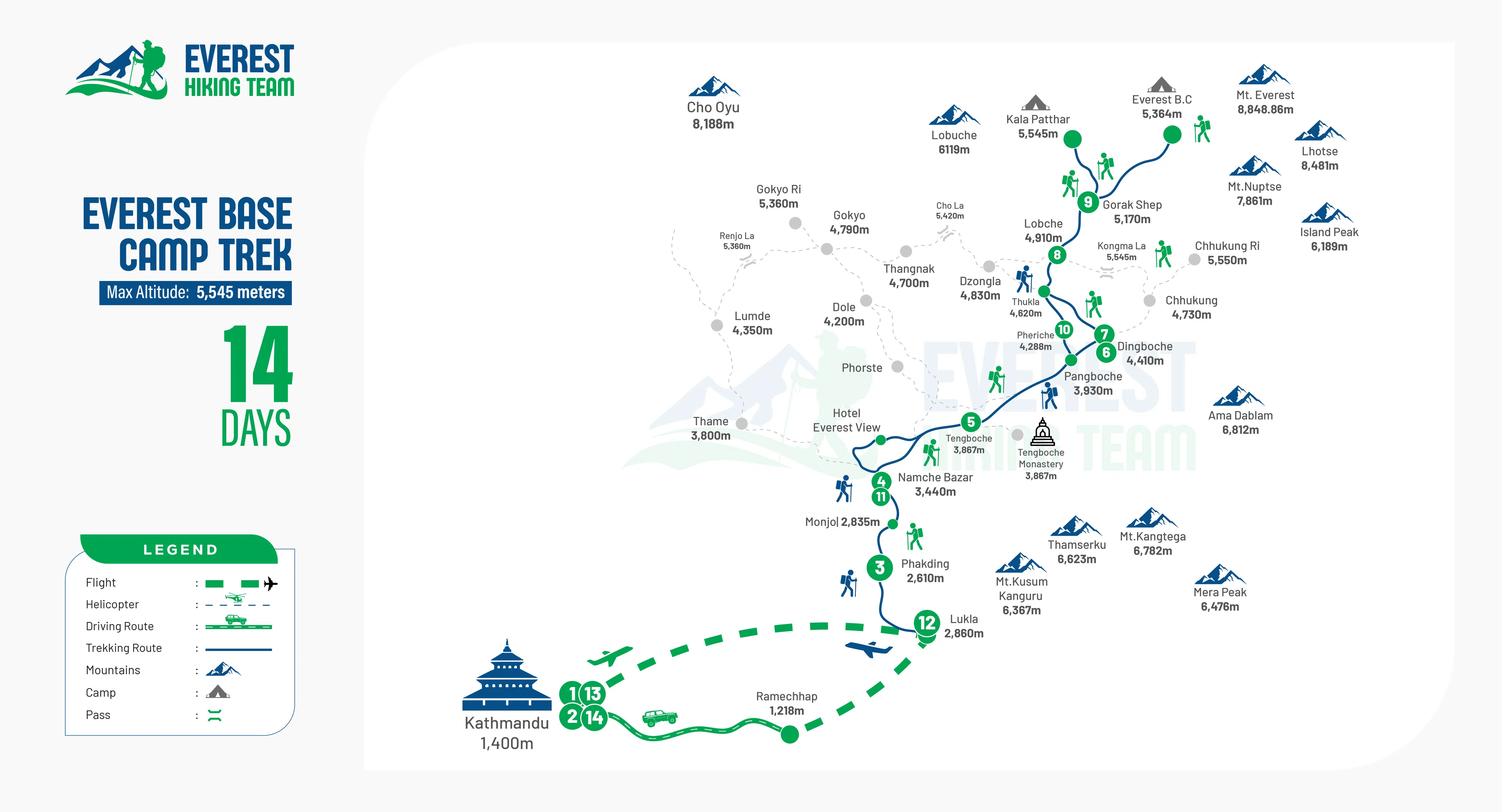
Trek Route

Everest Base Camp Trek-14 Days route image

What's included

  • Airport pickup and drop-off by private vehicle
  • 2 nights’ accommodation in a 3-star hotel in Kathmandu on a bed-and-breakfast basis
  • Welcome Dinner in kathmandu.
  • Pre-trek meeting and briefing
  • Sagarmatha National Park Permit
  • Pasang Lhamu Rural Municipality Entry Permit
  • All required government taxes and service charges
  • Accommodation in the tea house or lodge during the trek on a twin-sharing basis
  • All meal (Breakfast, Lunch, and Dinner with 3 cup of tea/coffee per day) during the trek
  • Licensed, English-speaking, and first-aid-trained trekking guide
  • Assistant guide for groups of more than six people
  • Guide and staff wages, food, accommodation, and equipment
  • Round-trip flights between Kathmandu-Lukla-Kathmandu or Ramechhap-Lukla-Ramechhap During peak season including airport transfers
  • Everest region trekking map
  • Comprehensive first-aid kit carried by the guide
  • Oximeter and oxygen can with the guide
  • Insurance for Nepalese trekking staff 
  • Assistance with rescue arrangements during a medical emergency, with valid travel insurance required
  • Final airport transfer according to your departure schedule

What's excluded

  • International airfare to and from Nepal
  • Nepal entry visa fees
  • Meals and extra accommodation in Kathmandu
  • Travel and medical insurance
  • Emergency helicopter evacuation costs not covered by your insurance
  • Hot showers, Wi-Fi, and battery charging during the trek
  • Extra meals and drinks, including alcoholic drinks, soft drinks, and bottled water
  • Upgraded accommodation during the trek
  • Personal clothing, trekking equipment, bags, and toiletries
  • Personal medicines and medical expenses
  • Special permits for filming, drones, or professional cameras
  • Any additional costs caused by flight delays, bad weather, or itinerary changes
  • Tips for guides, porters, and other trekking staff
  • Any other services or expenses not mentioned under Cost Includes

Packing List

The right packing list can make your Everest Base Camp Trek more comfortable and easier. Since the weather and temperature change as you gain altitude, you should carry warm, waterproof, and practical gear. At the same time, avoid packing unnecessary items that can add extra weight to your luggage.

General

  • Sleeping bag and down jacket (can be provided by the company and returned after the trek)
  • Duffle bag (provided by the company and returned after the trek)
  • Windproof and waterproof lightweight jacket
  • Daypack

Head, Ears and Eyewear

  • Warm hat that covers the ears
  • Sunglasses
  • Neck warmer
  • Sunscreen with SPF 35–60
  • Headlamp with extra batteries

Hands

  • Light gloves
  • Warm shell gloves
  • Glove liners

Upper Body

  • Long-sleeve T-shirts
  • Thermal tops
  • Fleece or wool jacket
  • Sports bras
  • Windproof and waterproof shell jacket

Lower Body

  • Thermal underwear
  • Windproof and waterproof trousers
  • Warm trekking trousers
  • Comfortable trekking pants
  • Extra casual or sports pants

Footwear

  • Waterproof trekking boots
  • Sandals
  • Light shoes or sneakers
  • 4–5 pairs of woolen socks
  • Sock liners

First Aid and Medicines

  • Adhesive bandages
  • Blister treatment
  • Anti-itch or insect ointment
  • Prescribed altitude-sickness medicine
  • Wound coverings and bandages
  • Water purification tablets
  • Personal medicines

Miscellaneous

  • Original passport
  • 4 passport-size photos
  • Water bottle and water filter
  • Copies of flight details
  • Toilet paper
  • Plastic bags
  • Wet wipes
  • Small towel
  • Soap and personal toiletries
  • Hand sanitizer

Extra Useful Items

  • Comfortable trekking poles
  • Energy bars or dry snacks
  • Power bank
  • Music player or headphones
  • Camera
  • Extra memory card
  • Camera charger and spare batteries

Frequently Asked Questions

Do I need previous trekking experience?

No, you don’t need prior trekking experience to successfully complete this ABC trek. If you have a good level of fitness, a positive attitude and have well-preparation, you can comfortably complete the trek. 

What is the highest altitude reached during the trek?

The highest point of this 14-day itinerary is Kala Patthar at 5,545 meters. Everest Base Camp is located at around 5,364 meters. The hike to Kala Patthar offers great views of Mount Everest, Lhotse, Nuptse, Pumori, and other mountains in the Khumbu region.

Do I need previous trekking experience for Everest Base Camp?

Previous trekking experience is not required for the Everest Base Camp Trek. However, you should have a good level of fitness and be comfortable with long walks. Regular hiking, walking, and cardio exercises before the trek can help you prepare for the high-altitude conditions.

What is the best season for the Everest Base Camp Trek?

Spring and autumn are the best seasons for the Everest Base Camp Trek. March, April, and May usually offer stable weather and good mountain views. September, October, and November are also popular, with clear skies, comfortable temperatures, and favorable trekking conditions.

What type of accommodation is available during the trek?

Accommodation during the trek is mainly provided in local tea houses and lodges. Rooms are usually simple, with beds, blankets, and basic furniture. Bathrooms may be shared, especially at higher elevations. Facilities become more basic as you get closer to Everest Base Camp.

Is travel insurance required for the Everest Base Camp Trek?

Travel insurance is strongly recommended for the Everest Base Camp Trek. Your insurance should cover high-altitude trekking, medical treatment, and emergency helicopter evacuation. Since the trek reaches over 5,000 meters and medical facilities are limited in remote areas, proper insurance is important for safety and financial protection

Can the Lukla flight be delayed or cancelled?

Yes, Lukla flights can sometimes be delayed or cancelled because of bad weather, poor visibility, or other operating conditions. Flight schedules can change without much notice. Keeping some flexibility in your travel plans is recommended, especially when traveling to and from the Everest region.

User Review